Geometry · Formation
Formation Control
Rigidity theory and distributed feedback for formations defined by distances, bearings, orientations, and mixed sensing constraints.
The questions behind the work
What we are trying to understand.
Formation control is a geometry problem before it is a feedback problem. We ask which local measurements uniquely encode a shape, and how that structure can be turned into distributed dynamics with reliable global behavior.
- 01
When do distances, bearings, or mixed measurements determine a formation uniquely?
- 02
How should a controller change when sensing is directed or the target has symmetry?
- 03
Which hidden motions or transmission zeros can prevent a formation from stabilizing?
Formation control studies how a team of agents can arrange itself into a spatial pattern using only local measurements and distributed controllers. The desired pattern may be encoded through relative positions, distances, bearings, orientations, or mixed sensing constraints, and the central question is whether those measurements contain enough geometry to stabilize the desired shape.
Our work uses rigidity theory as the organizing language for these problems. Rigidity connects the sensing graph to the geometry of the formation, making it possible to reason about uniqueness, local stability, directed sensing, maneuvering, and failure modes in a systematic way.
Bearing Rigidity
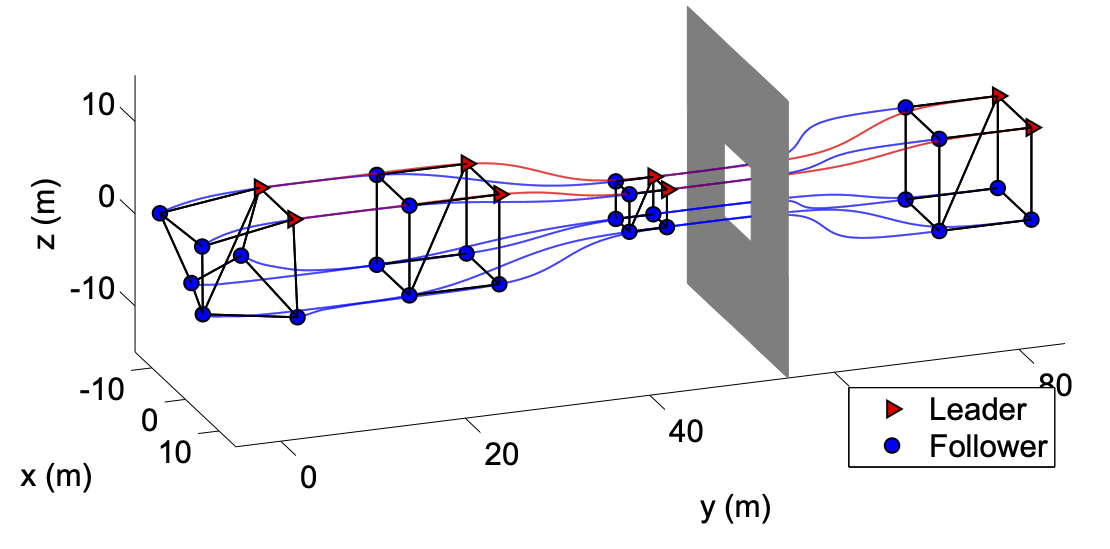
Bearing-based formation control uses direction measurements rather than distances. This is attractive for vision-based and sensor-limited robotic systems, but it requires a different rigidity theory because scale and translation symmetries appear naturally in the measurements.
Our work develops bearing rigidity theory, bearing localizability, bearing Laplacian methods, and rigidity conditions that determine when bearing measurements contain enough information to specify or stabilize a formation.
Representative Publications:
-
G. Michieletto, A. Cenedese, and D. Zelazo, “A Unified Dissertation on Bearing Rigidity Theory,” IEEE Transactions on Control of Network Systems, 8(4):1624–1636, 2021.
-
S. Zhao and D. Zelazo, “Bearing Rigidity Theory and its Applications for Control and Estimation of Network Systems: Life beyond distance rigidity,” IEEE Control Systems Magazine, 39(2):66–83, 2019.
-
S. Zhao, Z. Sun, D. Zelazo, M. H. Trinh, and H.-S. Ahn, “Laman Graphs are Generically Bearing Rigid in Arbitrary Dimensions,” in IEEE Conference on Decision and Control, Melbourne, Australia, Dec. 2017.
-
S. Zhao and D. Zelazo, “Bearing Rigidity and Almost Global Bearing-Only Formation Stabilization,” IEEE Transactions on Automatic Control, 61(6):1255–1268, 2016.
-
S. Zhao and D. Zelazo, “Localizability and distributed protocols for bearing-based network localization in arbitrary dimensions,” Automatica, 69:334–341, 2016.
-
D. Zelazo, P. R. Giordano, and A. Franchi, “Bearing-Only Formation Control Using an SE(2) Rigidity Theory,” in 54th IEEE Conference on Decision and Control, Osaka, Japan, Dec. 2015.
-
S. Zhao and D. Zelazo, “Bearing-Based Distributed Control and Estimation of Multi-Agent Systems,” in European Control Conference, Linz, Austria, Jul. 2015.
Directed Sensing and Directed Formations
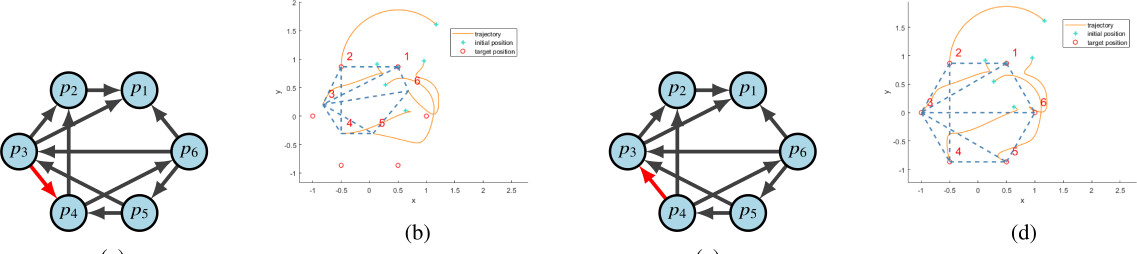
Directed sensing captures the asymmetry that appears in onboard perception: if one robot senses another, the reverse measurement is not automatically available. This changes the control problem because the sensing graph may be rigid when viewed as undirected while still failing to stabilize the directed formation dynamics.
Our recent and ongoing work separates this directed-sensing layer from classical bearing rigidity. It studies ordered leader-first-follower structures for bearing-only control, bearing equivalence and persistence in directed graphs, and a new geometric edge-space view of directed distance-based formation control. In that newer work, persistence is not the right dividing line; target-dependent stability, dynamic admissibility, and algebraic admissibility provide sharper tests for directed controllers.
Representative Publications:
-
J. Shi and D. Zelazo, “Extending the Leader-First Follower Structure for Bearing-only Formation Control on Directed Graphs,” IEEE Transactions on Control of Network Systems, 13(1):179–190, 2026.
-
L. Theran, D. Zelazo, and J. Sidman, “A Geometric View of Formation Control with Application to Directed Sensing,” Dec. 2025.
-
J. Shi and D. Zelazo, “Bearing-only Formation Control with Directed Sensing,” in 63rd Israel Annual Conference on Aerospace Sciences, Haifa, Israel, May 2024.
-
Z. Sun, S. Zhao, and D. Zelazo, “Characterizing bearing persistence in directed graphs,” in IFAC World Congress, Yokohama, Japan, Jul. 2023.
-
M. H. Trinh, S. Zhao, Z. Sun, D. Zelazo, B. D. O. Anderson, and H. Ahn, “Bearing-Based Formation Control of A Group of Agents with Leader-First Follower Structure,” IEEE Transactions on Automatic Control, 64(2):598–613, 2019.
-
M. H. Trinh, D. Mukherjee, D. Zelazo, and H.-S. Ahn, “Formations on Directed Cycles with Bearing-Only Measurements,” International Journal of Robust and Nonlinear Control, 28(3):1074–1096, 2018.
-
S. Zhao and D. Zelazo, “Bearing-Based Formation Stabilization with Directed Interaction Topologies,” in 54th IEEE Conference on Decision and Control, Osaka, Japan, Dec. 2015.
Symmetry, Distance Geometry, and Hidden Modes
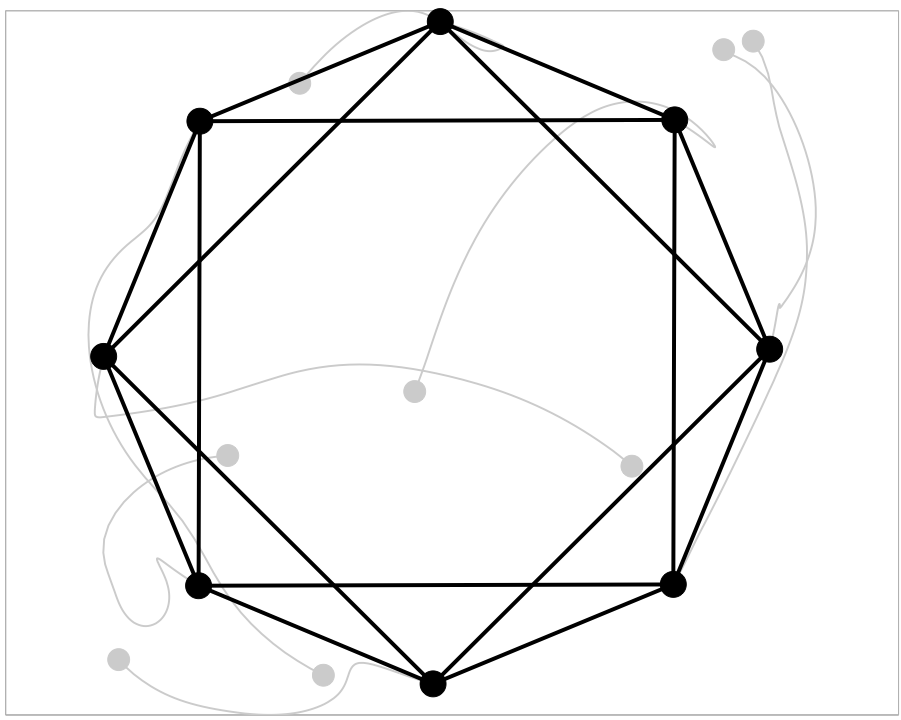
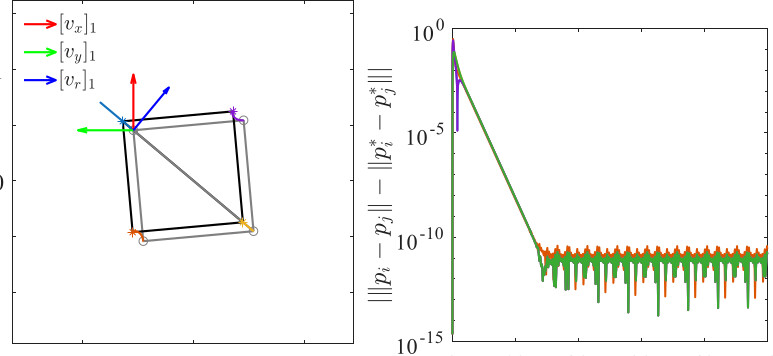
Symmetry can be used as a design feature in formation control, but it can also create hidden modes and transmission zeros that are difficult to see from local measurements alone. Distance-based and symmetry-constrained formations therefore require tools that connect group actions, graph structure, and closed-loop behavior.
This line of work studies forced symmetric formations, rotation and dihedral constraints, distance-based transmission zeros, and the geometric obstructions that arise when the formation architecture hides internal motion.
Representative Publications:
-
Z. Martinez and D. Zelazo, “Symmetry-Based Formation Control on Cycle Graphs Using Dihedral Point Groups,” in IFAC World Congress, Busan, South Korea, Aug. 2026.
-
S. Goldgraber Casspi and D. Zelazo, “The Geometry of Hidden Modes in Distance-Based Formation Control,” in IFAC World Congress, Busan, South Korea, Aug. 2026.
-
S. Goldgraber Casspi and D. Zelazo, “The Geometry of Transmission Zeros in Distance-Based Formations,” IEEE Control Systems Letters, 10:1069–1074, 2026.
-
Z. Martinez and D. Zelazo, “Formation Control via Rotation Symmetry Constraints,” in American Control Conference, New Orleans, LA, USA, May 2026.
-
D. Zelazo, S.-ichi Tanigawa, and B. Schulze, “Forced Symmetric Formation Control,” IEEE Transactions on Control of Network Systems, 12(2):1415–1426, 2025.
-
Z. Martinez and D. Zelazo, “Symmetry-Constrained Formation Maneuvering,” in 64th Israel Annual Conference on Aerospace Sciences, Haifa, Israel, Mar. 2025.
-
D. Zelazo, B. Shulze, and S.-I. Tanigawa, “Stabilization of Symmetric Formations,” in IFAC World Congress, Yokohama, Japan, Jul. 2023.
-
O. Rozenheck, S. Zhao, and D. Zelazo, “A Proportional-Integral Controller for Distance-Based Formation Tracking,” in European Control Conference, Linz, Austria, Jul. 2015.
Maneuvering, Maintenance, and Robotic Formations
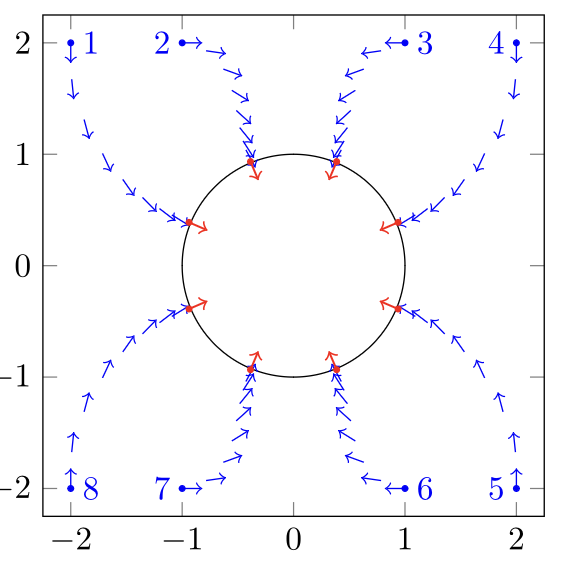
Formation control must also work while the formation is moving, reconfiguring, or operating with uncertain measurements and constraints. This includes rigidity maintenance, bounded disturbances, spacecraft and aerial formations, relay positioning, pursuit, and cooperative behaviors that balance competing objectives.
These problems connect the formation-control theory to robotic implementation and to broader questions about how teams should preserve useful geometry during motion.
Representative Publications:
-
F. Oliva, D. Zelazo, and A. Degani, “Balancing Expansion and Contraction: Coordinating Multi-Agent Teams Under Competing Goals,” in International Conference Series on Climbing and Walking Robots (CALWAR), Cranfield, UK, Sep. 2026.
-
C. Xu, D. Zelazo, and B. Wu, “Distributed Prescribed-Time Coordinated Control of Spacecraft Formation Flying under Input Saturation,” Advances in Space Research, 74(5):2302–2315, 2024.
-
C. Xu, D. Zelazo, and B. Wu, “Bearing-based formation control of second-order multiagent systems with bounded disturbances,” International Journal on Robust and Nonlinear Control, 34(1):167–199, 2024.
-
M. Fabris and D. Zelazo, “Bearing-based Autonomous Communication Relay Positioning under Field-of-View Constraints,” Advanced Control for Applications, 4(2):e103, 2022.
-
Y. Liu, J. M. Montenbruck, D. Zelazo, M. Odelga, S. Rajappa, H. H. Bülthoff, F. Allgöwer, and A. Zell, “A Distributed Control Approach to Formation Balancing and Maneuvering of Multiple Multirotor UAVs,” IEEE Transactions on Robotics, 34(4):870–882, 2018.
-
J. M. Montenbruck, D. Zelazo, and F. Allgöwer, “Fekete Points, Formation Control, and the Balancing Problem,” IEEE Transactions on Automatic Control, 62(10):5069–5081, 2017.
-
D. Zelazo, A. Franchi, H. H. Bülthoff, and P. Robuffo Giordano, “Decentralized Rigidity Maintenance Control with Range-only Measurements for Multi-Robot Systems,” International Journal of Robotics Research, 34(1):105–128, 2015.
-
D. Zelazo, A. Franchi, F. Allgöwer, H. H. Bülthoff, and P. Robuffo Giordano, “Rigidity Maintenance Control for Multi-Robot Systems,” in Proceedings of Robotics: Science and Systems, Sydney, Australia, Jul. 2012.
Complete Related Publications
Related Publications:
-
F. Yue and D. Zelazo, “Transversal Passivity and Equilibrium Forces in Formation Control,” Nov. 2026.
-
L. Theran, D. Zelazo, S. Dewar, and B. Schulze, “Formation control from the generic combinatorial viewpoint: edge dynamics and directed sensing,” Sep. 2026.
-
F. Oliva, D. Zelazo, and A. Degani, “Balancing Expansion and Contraction: Coordinating Multi-Agent Teams Under Competing Goals,” in International Conference Series on Climbing and Walking Robots (CALWAR), Cranfield, UK, Sep. 2026.
-
Z. Martinez and D. Zelazo, “Symmetry-Based Formation Control on Cycle Graphs Using Dihedral Point Groups,” in IFAC World Congress, Busan, South Korea, Aug. 2026.
-
S. Goldgraber Casspi and D. Zelazo, “The Geometry of Hidden Modes in Distance-Based Formation Control,” in IFAC World Congress, Busan, South Korea, Aug. 2026.
-
S. Goldgraber Casspi and D. Zelazo, “The Geometry of Transmission Zeros in Distance-Based Formations,” IEEE Control Systems Letters, 10:1069–1074, 2026.
-
Z. Martinez and D. Zelazo, “Formation Control via Rotation Symmetry Constraints,” in American Control Conference, New Orleans, LA, USA, May 2026.
-
Z. Martinez, “Formation Control via Rotation Symmetry Constraints,” in IAAC Workshop: Graduate Students in Systems and Control, Tel-Aviv, Israel, Apr. 2026.
-
J. Shi and D. Zelazo, “Extending the Leader-First Follower Structure for Bearing-only Formation Control on Directed Graphs,” IEEE Transactions on Control of Network Systems, 13(1):179–190, 2026.
-
L. Theran, D. Zelazo, and J. Sidman, “A Geometric View of Formation Control with Application to Directed Sensing,” Dec. 2025.
-
Z. Martinez, “Symmetry-Constrained Formation Maneuvering,” in IAAC Workshop: Graduate Students in Systems and Control, Haifa, Israel, Jul. 2025.
-
D. Zelazo, S.-ichi Tanigawa, and B. Schulze, “Forced Symmetric Formation Control,” IEEE Transactions on Control of Network Systems, 12(2):1415–1426, 2025.
-
Z. Martinez and D. Zelazo, “Symmetry-Constrained Formation Maneuvering,” in 64th Israel Annual Conference on Aerospace Sciences, Haifa, Israel, Mar. 2025.
-
C. Xu, D. Zelazo, and B. Wu, “Distributed Prescribed-Time Coordinated Control of Spacecraft Formation Flying under Input Saturation,” Advances in Space Research, 74(5):2302–2315, 2024.
-
C. Xu, D. Zelazo, and B. Wu, “Bearing-based formation control of second-order multiagent systems with bounded disturbances,” International Journal on Robust and Nonlinear Control, 34(1):167–199, 2024.
-
J. Shi and D. Zelazo, “Bearing-only Formation Control with Directed Sensing,” in 63rd Israel Annual Conference on Aerospace Sciences, Haifa, Israel, May 2024.
-
M. Sewlia and D. Zelazo, “Bearing-Based Formation Stabilization Using Event-Triggered Control,” International Journal on Robust and Nonlinear Control, 34(6):4375–4387, 2024.
-
J. Shi, “Bearing-only Formation Control with Directed Sensing,” mastersthesis, Technion - Israel Institute of Technology, Autonomous Systems and Robotics, 2024.
-
Z. Sun, S. Zhao, and D. Zelazo, “Characterizing bearing persistence in directed graphs,” in IFAC World Congress, Yokohama, Japan, Jul. 2023.
-
D. Zelazo, B. Shulze, and S.-I. Tanigawa, “Stabilization of Symmetric Formations,” in IFAC World Congress, Yokohama, Japan, Jul. 2023.
-
M. Fabris and D. Zelazo, “Bearing-based Autonomous Communication Relay Positioning under Field-of-View Constraints,” Advanced Control for Applications, 4(2):e103, 2022.
-
B. Pozzan, G. Michieletto, A. Cenedese, and D. Zelazo, “Heterogeneous Formation Control: a Bearing Rigidity Approach,” in IEEE Conference on Decision and Control, Austin, Texas, Dec. 2021.
-
G. Michieletto, A. Cenedese, and D. Zelazo, “A Unified Dissertation on Bearing Rigidity Theory,” IEEE Transactions on Control of Network Systems, 8(4):1624–1636, 2021.
-
M. H. Trinh, D. Zelazo, and H.-S. Ahn, “Pointing Consensus and Bearing-Based Solutions to the Fermat–Weber Location Problem,” IEEE Transactions on Automatic Control, 65(6):2339–2354, 2020.
-
M. Sewlia, “Distributed Event-Triggered Control for Multi-Agent Systems with Second-Order Dynamics,” mastersthesis, Technion - Israel Institute of Technology, Aerospace Engineering Department, 2020.
-
T. Ikeda, D. Zelazo, and K. Kashima, “Maximum Hands-Off Distributed Bearing-Based Formation Control,” in IEEE Conference on Decision and Control, Nice, France, Dec. 2019.
-
D. Zelazo and S. Zhao, “Formation Control and Rigidity Theory,” Snapshots of Modern Mathematics from Oberwolfach, (12):1–16, 2019.
-
A. Jain and D. Zelazo, “Temporal Circular Formation Control with Bounded Trajectories in a Uniform Flowfield,” in 27th Mediterranean Conference on Control and Automation, Akko, Israel, Jul. 2019.
-
Q. Van Tran, M. H. Trinh, D. Zelazo, D. Mukherjee, and H.-S. Ahn, “Finite-Time Bearing-Only Formation Control via Distributed Global Orientation Estimation,” IEEE Transactions on Control of Network Systems, 6(2):702–712, 2019.
-
S. Zhao and D. Zelazo, “Bearing Rigidity Theory and its Applications for Control and Estimation of Network Systems: Life beyond distance rigidity,” IEEE Control Systems Magazine, 39(2):66–83, 2019.
-
M. H. Trinh, S. Zhao, Z. Sun, D. Zelazo, B. D. O. Anderson, and H. Ahn, “Bearing-Based Formation Control of A Group of Agents with Leader-First Follower Structure,” IEEE Transactions on Automatic Control, 64(2):598–613, 2019.
-
D. Goldenberg, “Cooperative Object Manipulation A Rigidity Approach,” mastersthesis, Technion - Israel Institute of Technology, Aerospace Engineering Department, 2019.
-
D. Frank, D. Zelazo, and F. Allgöwer, “Bearing-Only Formation Control with Limited Visual Sensing: Two Agent Case,” in 7th IFAC Workshop on Distributed Estimation and Control in Networked System , Groningen, The Netherlands, Sep. 2018.
-
M. H. Trinh, D. Mukherjee, D. Zelazo, and H.-S. Ahn, “Formations on Directed Cycles with Bearing-Only Measurements,” International Journal of Robust and Nonlinear Control, 28(3):1074–1096, 2018.
-
Y. Liu, J. M. Montenbruck, D. Zelazo, M. Odelga, S. Rajappa, H. H. Bülthoff, F. Allgöwer, and A. Zell, “A Distributed Control Approach to Formation Balancing and Maneuvering of Multiple Multirotor UAVs,” IEEE Transactions on Robotics, 34(4):870–882, 2018.
-
D. Frank, “Bearing-only Formation Control with Limited View Constraints,” mastersthesis, University of Stuttgart, 2018.
-
M. H. Trinh, D. Mukherjee, D. Zelazo, and H.-S. Ahn, “Finite-time bearing-only formation control,” in IEEE Conference on Decision and Control, Melbourne, Australia, Dec. 2017.
-
S. Zhao, Z. Sun, D. Zelazo, M. H. Trinh, and H.-S. Ahn, “Laman Graphs are Generically Bearing Rigid in Arbitrary Dimensions,” in IEEE Conference on Decision and Control, Melbourne, Australia, Dec. 2017.
-
J. M. Montenbruck, D. Zelazo, and F. Allgöwer, “Fekete Points, Formation Control, and the Balancing Problem,” IEEE Transactions on Automatic Control, 62(10):5069–5081, 2017.
-
S. Zhao and D. Zelazo, “Translational and Scaling Formation Maneuver Control via a Bearing-Based Approach,” IEEE Transactions on Control of Network Systems, 4(3):429–438, 2017.
-
M. H. Trinh, D. Mukherjee, D. Zelazo, and H.-S. Ahn, “Planar Bearing-only Cyclic Pursuit for Target Capture,” in IFAC World Congress, Toulouse, France, Jul. 2017.
-
D. Mukherjee, M. H. Trinh, D. Zelazo, and H.-S. Ahn, “Bearing-only Cyclic Pursuit in 2-D for Capture of Moving Target,” in 57th Israel Annual Conference on Aerospace Sciences , Tel-Aviv, Israel, Feb. 2017.
-
F. Schiano, A. Franchi, D. Zelazo, and P. R. Giordano, “A Rigidity-Based Decentralized Bearing Formation Controller for Groups of Quadrotor UAVs,” in IEEE/RSJ International Conference on Intelligent Robots and Systems, Daejeon, Korea, Sep. 2016.
-
S. Zhao and D. Zelazo, “Bearing Rigidity and Almost Global Bearing-Only Formation Stabilization,” IEEE Transactions on Automatic Control, 61(6):1255–1268, 2016.
-
S. Zhao and D. Zelazo, “Localizability and distributed protocols for bearing-based network localization in arbitrary dimensions,” Automatica, 69:334–341, 2016.
-
D. Mukherjee, M. H. Trinh, D. Zelazo, and H.-S. Ahn, “Robustness of Heterogeneous Cyclic Pursuit,” in 56th Israel Annual Conference on Aerospace Sciences , Tel-Aviv, Israel, Feb. 2016.
-
O. Rozenheck, “Distance-Constrained Formation Tracking Control,” mastersthesis, Technion - Israel Institute of Technology, Aerospace Engineering Department, 2016.
-
M. M. Montenbruck, D. Zelazo, and F. Allgöwer, “Retraction Balancing and Formation Control,” in 54th IEEE Conference on Decision and Control, Osaka, Japan, Dec. 2015.
-
D. Zelazo, P. R. Giordano, and A. Franchi, “Bearing-Only Formation Control Using an SE(2) Rigidity Theory,” in 54th IEEE Conference on Decision and Control, Osaka, Japan, Dec. 2015.
-
S. Zhao and D. Zelazo, “Bearing-Based Formation Stabilization with Directed Interaction Topologies,” in 54th IEEE Conference on Decision and Control, Osaka, Japan, Dec. 2015.
-
S. Zhao and D. Zelazo, “Bearing-Based Formation Maneuvering,” in IEEE International Symposium on Intelligent Control, Sydney, Australia, Sep. 2015.
-
O. Rozenheck, S. Zhao, and D. Zelazo, “A Proportional-Integral Controller for Distance-Based Formation Tracking,” in European Control Conference, Linz, Austria, Jul. 2015.
-
S. Zhao and D. Zelazo, “Bearing-Based Distributed Control and Estimation of Multi-Agent Systems,” in European Control Conference, Linz, Austria, Jul. 2015.
-
O. Rozenheck, S. Zhao, and D. Zelazo, “Formation Velocity Tracking with Proportional Control,” in 55th Israel Annual Conference on Aerospace Sciences , Haifa, Israel, Feb. 2015.
-
D. Zelazo, A. Franchi, H. H. Bülthoff, and P. Robuffo Giordano, “Decentralized Rigidity Maintenance Control with Range-only Measurements for Multi-Robot Systems,” International Journal of Robotics Research, 34(1):105–128, 2015.
-
D. Zelazo, A. Franchi, and P. R. Giordano, “Rigidity Theory in SE(2) for Unscaled Relative Position Estimation Using Only Bearing Measurements,” in European Control Conference, Strasbourg, France, Jun. 2014.
-
D. Zelazo, A. Franchi, F. Allgöwer, H. H. Bülthoff, and P. Robuffo Giordano, “Rigidity Maintenance Control for Multi-Robot Systems,” in Proceedings of Robotics: Science and Systems, Sydney, Australia, Jul. 2012.
-
D. Zelazo and F. Allgöwer, “Growing Optimally Rigid Formations,” in American Control Conference, Montreal, Canada, 2012.
-
D. Zelazo, A. Rahmani, J. Sandhu, and M. Mesbahi, “Decentralized Formation Control via the Edge Laplacian,” in American Control Conference, Seattle, WA, Jun. 2008.