Information-aware control · Event Trigger
Event Triggered Control and Estimation
Control and estimation strategies that communicate or update only when new information is sufficiently useful.
The questions behind the work
What we are trying to understand.
Communication is a control resource. Event-triggered methods decide when information is valuable enough to transmit, while sampled-data analysis explains what stability and accuracy survive between updates.
- 01
When is a new measurement informative enough to justify communication?
- 02
How much sampling, delay, and asynchrony can a distributed controller tolerate?
- 03
Can communication be reduced without sacrificing formation or estimation accuracy?
Continuous sensing and communication can be expensive for autonomous systems, especially when many agents must coordinate over shared or unreliable communication channels. Event-triggered and sampled-data strategies reduce this burden by updating only when new information is useful enough to justify communication or actuation.
This page focuses on event-triggered control, event-triggered estimation, and asynchronous sampled-data synchronization. Formation, filtering, and consensus results are included here when the triggering or sampling mechanism is the main contribution.
Event-Triggered Estimation
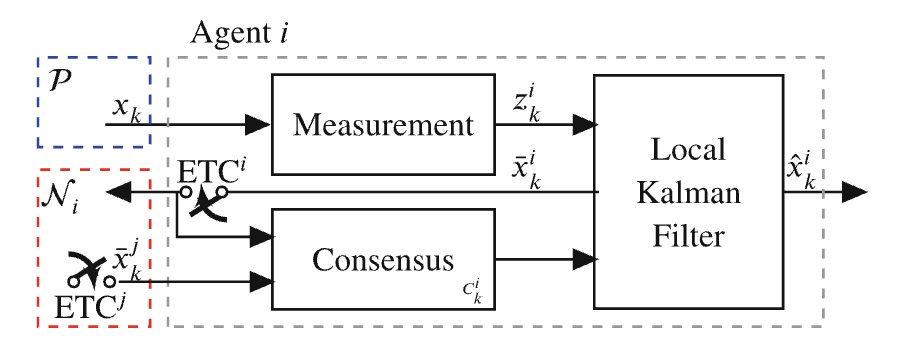
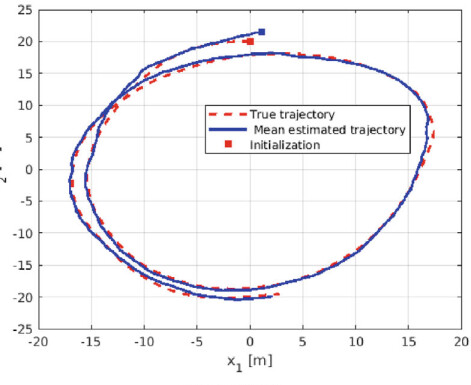
Distributed estimation problems require agents to fuse intermittent observations and neighbor information while maintaining filter consistency. Event-triggered consensus Kalman filtering studies when communication can be skipped without compromising estimation quality.
Our work develops filter architectures for time-varying graphs, intermittent measurements, and event-based information exchange.
Representative Publications:
-
A. Priel and D. Zelazo, “Distributed Consensus Kalman Filtering Over Time-Varying Graphs,” in IFAC World Congress, Yokohama, Japan, Jul. 2023.
-
A. Priel and D. Zelazo, “Event-triggered consensus Kalman filtering for time-varying networks and intermittent observations,” International Journal of Robust and Nonlinear Control, 33(13):7430–7451, 2023.
-
A. Priel, “Consensus Kalman Filtering: Filter Design and Event-Triggering,” mastersthesis, Technion - Israel Institute of Technology, Aerospace Engineering Department, 2022.
-
A. Priel and D. Zelazo, “An Improved Distributed Consensus Kalman Filter Design Approach,” in IEEE Conference on Decision and Control, Austin, Texas, Dec. 2021.
Event-Based Formation Control
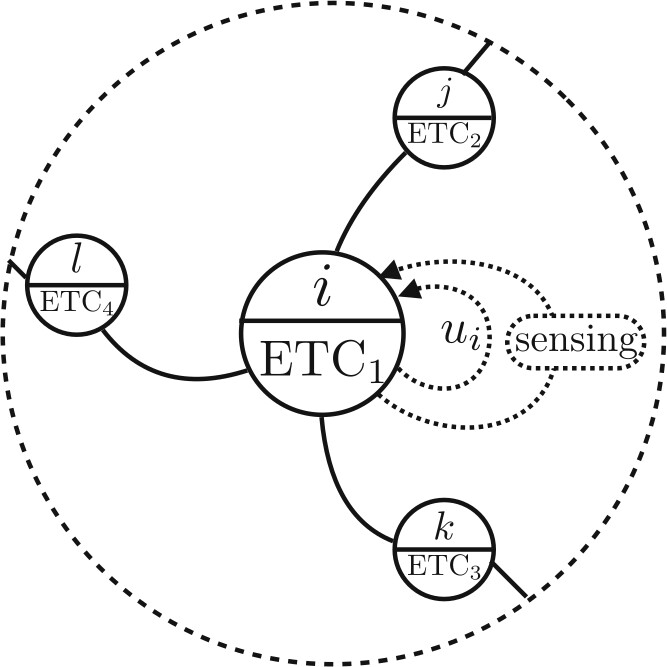
In formation control, event-triggered mechanisms reduce communication while preserving the geometric constraints needed for convergence. The trigger must account for both the agent dynamics and the formation objective, since stale measurements can degrade stability or distort the desired formation.
This work connects event-triggered control with bearing-based formation stabilization and second-order multi-agent dynamics.
Representative Publications:
-
M. Sewlia and D. Zelazo, “Bearing-Based Formation Stabilization Using Event-Triggered Control,” International Journal on Robust and Nonlinear Control, 34(6):4375–4387, 2024.
-
M. Sewlia, “Distributed Event-Triggered Control for Multi-Agent Systems with Second-Order Dynamics,” mastersthesis, Technion - Israel Institute of Technology, Aerospace Engineering Department, 2020.
-
M. Sewlia and D. Zelazo, “Distributed Event-Based Control for Second-Order Multi-Agent Systems,” in 27th Mediterranean Conference on Control and Automation, Akko, Israel, Jul. 2019.
Sampled-Data and Asynchronous Synchronization
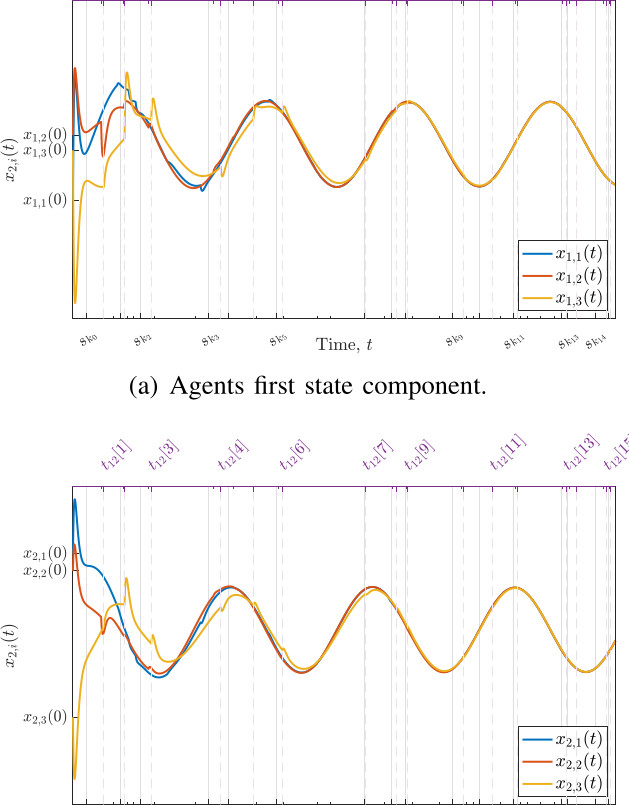
Sampled-data synchronization studies how networked systems behave when agents communicate and update at discrete or asynchronous times. Rather than assuming continuous access to neighbor signals, the controller must tolerate sampling, delays, and irregular updates.
Our recent work develops emulation and asynchronous sampled-data approaches for output-feedback synchronization with small communication delays.
Representative Publications:
-
G. Barkai, L. Mirkin, and D. Zelazo, “Asynchronous Sampled-Data Synchronization with Small Communications Delays,” in IEEE Conference on Decision and Control, Milan, Italy, Dec. 2024.
-
G. Barkai, L. Mirkin, and D. Zelazo, “An Emulation Approach to Output-Feedback Sampled-Data Synchronization,” in European Control Conference, Stockholm, Sweden, Jun. 2024.
-
G. Barkai, L. Mirkin, and D. Zelazo, “Asynchronous Sampled-Data Synchronization with Small communication Delays,” in 63rd Israel Annual Conference on Aerospace Sciences, Haifa, Israel, May 2024.
-
G. Barkai, L. Mirkin, and D. Zelazo, “An emulation approach to sampled-data synchronization,” in IEEE Conference on Decision and Control, Singapore, Dec. 2023.
Complete Related Publications
Related Publications:
-
G. Barkai, L. Mirkin, and D. Zelazo, “Asynchronous Sampled-Data Synchronization with Small Communications Delays,” in IEEE Conference on Decision and Control, Milan, Italy, Dec. 2024.
-
G. Barkai, L. Mirkin, and D. Zelazo, “An Emulation Approach to Output-Feedback Sampled-Data Synchronization,” in European Control Conference, Stockholm, Sweden, Jun. 2024.
-
G. Barkai, L. Mirkin, and D. Zelazo, “Asynchronous Sampled-Data Synchronization with Small communication Delays,” in 63rd Israel Annual Conference on Aerospace Sciences, Haifa, Israel, May 2024.
-
M. Sewlia and D. Zelazo, “Bearing-Based Formation Stabilization Using Event-Triggered Control,” International Journal on Robust and Nonlinear Control, 34(6):4375–4387, 2024.
-
G. Barkai, L. Mirkin, and D. Zelazo, “An emulation approach to sampled-data synchronization,” in IEEE Conference on Decision and Control, Singapore, Dec. 2023.
-
A. Priel and D. Zelazo, “Distributed Consensus Kalman Filtering Over Time-Varying Graphs,” in IFAC World Congress, Yokohama, Japan, Jul. 2023.
-
A. Priel and D. Zelazo, “Event-triggered consensus Kalman filtering for time-varying networks and intermittent observations,” International Journal of Robust and Nonlinear Control, 33(13):7430–7451, 2023.
-
A. Priel, “Consensus Kalman Filtering: Filter Design and Event-Triggering,” mastersthesis, Technion - Israel Institute of Technology, Aerospace Engineering Department, 2022.
-
A. Priel and D. Zelazo, “An Improved Distributed Consensus Kalman Filter Design Approach,” in IEEE Conference on Decision and Control, Austin, Texas, Dec. 2021.
-
M. Sewlia, “Distributed Event-Triggered Control for Multi-Agent Systems with Second-Order Dynamics,” mastersthesis, Technion - Israel Institute of Technology, Aerospace Engineering Department, 2020.
-
M. Sewlia and D. Zelazo, “Distributed Event-Based Control for Second-Order Multi-Agent Systems,” in 27th Mediterranean Conference on Control and Automation, Akko, Israel, Jul. 2019.