Optimization over networks appears in two complementary ways in our research. First, distributed algorithms allow agents to solve a shared optimization or decision-making problem using only local communication. Second, optimization provides a language for analyzing complex networked dynamical systems, including passivity-based control, clustering, sparse design, and cooperative seeking.
This page focuses on the optimization layer itself. Energy dispatch, passivity, and network identification papers are included when their main contribution is also tagged as optimization.
Distributed Negotiation and Decision Making
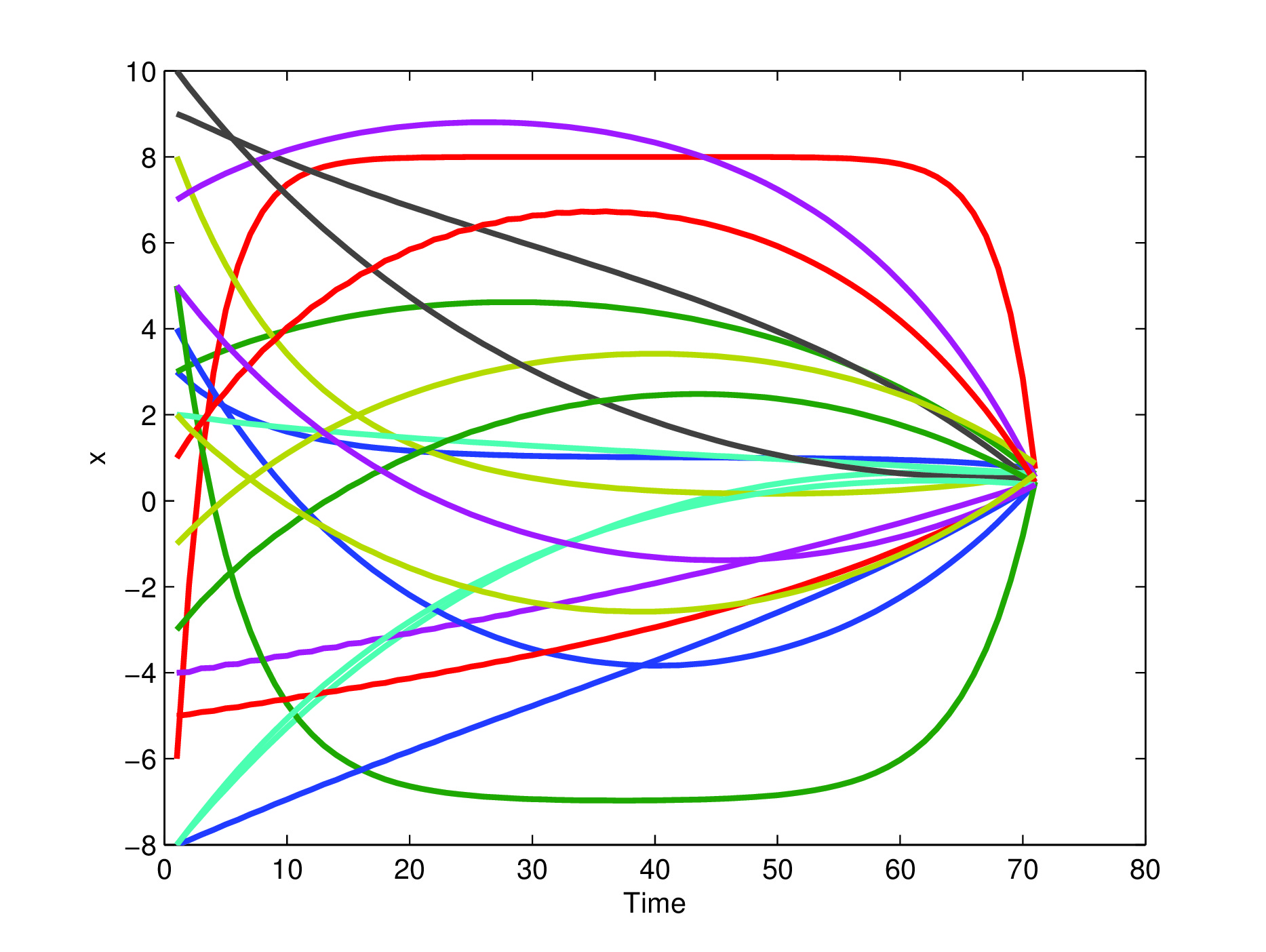
Distributed negotiation problems model agents that must agree on a decision while respecting local preferences, dynamics, and communication constraints. The resulting algorithms blend optimization, agreement protocols, and feedback interconnections.
Our work studies finite-time dual methods, switching communication, real-time preference-based agreement, and negotiation with connectivity constraints.
Distributed decision making and cooperative optimization over a network.
Representative Publications:
Y. Ben Shoushan and D. Zelazo, “Negotiation Between Dynamical Systems with Connectivity Constraints,” in 57th Israel Annual Conference on Aerospace Sciences , Tel-Aviv, Israel, Feb. 2017.
@inproceedings{Shoushan2017,
  address = {Tel-Aviv, Israel},
  author = {{Ben Shoushan}, Y and Zelazo, D},
  booktitle = {57th Israel Annual Conference on Aerospace Sciences },
  keywords = {conference},
  month = feb,
  pages = {},
  researchtopic = {nds, optimization},
  title = {Negotiation Between Dynamical Systems with Connectivity Constraints},
  pdf = {/Publications/Shoushan_IACAS2017.pdf},
  year = {2017}
}
Y. Ben-Shoushan, “Negotiation between Dynamical Systems with Connectivity Constraints,” mastersthesis, Technion - Israel Institute of Technology, Aerospace Engineering Department, 2017.
@thesis{BenShoushan2017,
  author = {Ben-Shoushan, Yaniv},
  title = {Negotiation between Dynamical Systems with Connectivity Constraints},
  school = {Technion - Israel Institute of Technology, Aerospace Engineering Department},
  year = {2017},
  type = {mastersthesis},
  researchtopic = {thesis, nds, optimization},
  pdf = {/Theses/Thesis_BenShoushan.pdf}
}
D. Zelazo, M. Bürger, and F. Allgöwer, “A Finite-Time Dual Method for Negotiation between Dynamical Systems,” SIAM Journal on Control and Optimization, 51(1):172–194, 2013.
@article{Zelazo2013_J,
  author = {Zelazo, Daniel and B\"{u}rger, Mathias and Allg\"{o}wer, Frank},
  doi = {10.1137/100819175},
  issn = {0363-0129},
  journal = {SIAM Journal on Control and Optimization},
  keywords = {distributed optimization,finite-time consensus,multiagent systems,subgradient},
  month = jan,
  number = {1},
  pages = {172--194},
  researchtopic = {optimization},
  title = {{A Finite-Time Dual Method for Negotiation between Dynamical Systems}},
  url = {http://epubs.siam.org/doi/abs/10.1137/100819175},
  volume = {51},
  year = {2013},
  pdf = {/Publications/Zelazo_SIAMJCO2013.pdf}
}
D. Zelazo, M. Bürger, and F. Allgöwer, “Dynamic Negotiation Under Switching Communication,” in Mathematical System Theory – Festschrift in Honor of Uwe Helmke on the Occasion of his Sixtieth Birthday, K. Hüper and J. Trumpf, Eds. CreateSpace, 2013, p. 479500.
@incollection{Zelazo2012b,
  author = {Zelazo, Daniel and B\"{u}rger, Mathias and Allg\"{o}wer, Frank},
  booktitle = {Mathematical System Theory -- Festschrift in Honor of Uwe Helmke on the Occasion of his Sixtieth Birthday},
  editor = {H\"{u}per, K and Trumpf, J},
  file = {:Users/danielzelazo/Dropbox/Research/Mendeley Paper Database/Zelazo, B\"{u}rger, Allg\"{o}wer/Mathematical System Theory -- Festschrift in Honor of Uwe Helmke on the Occasion of his Sixtieth Birthday/Zelazo, B\"{u}rger, Allg\"{o}wer - 2013 - Dynamic Negotiation Under Switching Communication.pdf:pdf},
  isbn = {978-1470044008},
  pages = {479----500},
  publisher = {CreateSpace},
  title = {{Dynamic Negotiation Under Switching Communication}},
  url = {http://users.cecs.anu.edu.au/~trumpf/UH60Festschrift.pdf},
  year = {2013},
  researchtopic = {optimization}
}
D. Zelazo, M. Bürger, and F. Allgöwer, “A Distributed Real-Time Algorithm for Preference-Based Agreement,” in Proc. 18th IFAC World Congress, Milan, Italy, Aug. 2011.
@inproceedings{Zelazo2011,
  address = {Milan, Italy},
  author = {Zelazo, Daniel and B\"{u}rger, Mathias and Allg\"{o}wer, Frank},
  booktitle = {Proc. 18th IFAC World Congress},
  doi = {10.3182/20110828-6-IT-1002.03155},
  editor = {Sergio, Bittanti},
  keywords = {conference},
  month = aug,
  pages = {8933--8938},
  researchtopic = {nds, optimization},
  title = {{A Distributed Real-Time Algorithm for Preference-Based Agreement}},
  url = {http://www.ifac-papersonline.net/Detailed/50415.html},
  year = {2011},
  pdf = {/Publications/Zelazo_IFAC11.pdf}
}
Network Design, Clustering, and Sparsity
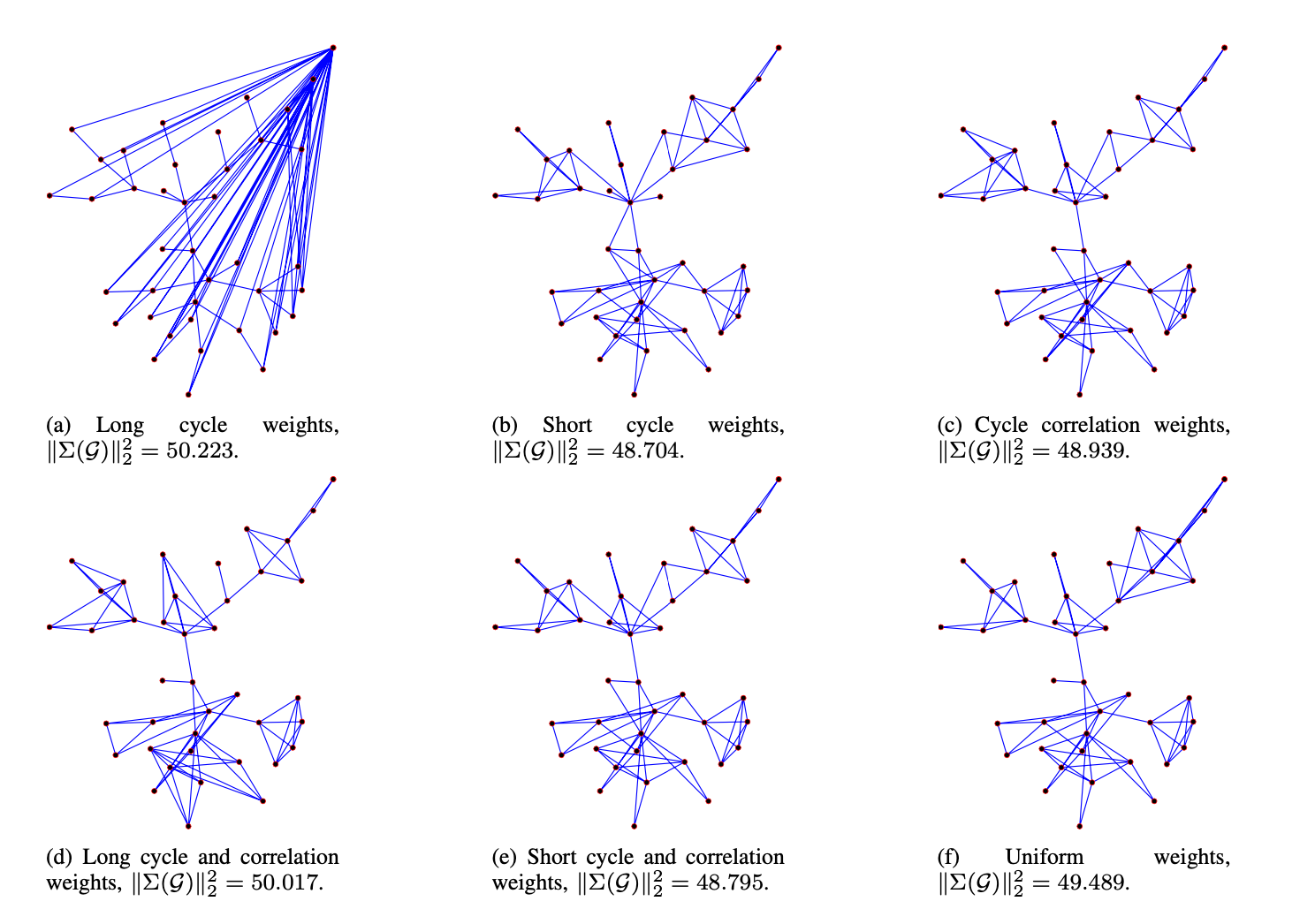
Many networked-control problems ask for a graph, weighting, or sparsity pattern that optimizes performance while preserving structural properties. These questions connect graph theory, convex optimization, and dynamical-systems analysis.
Our work studies sparse relative sensing networks, cycle design, clustering in dynamical networks, and optimization-based graph synthesis.
Network design problems connect graph structure to closed-loop performance.
Representative Publications:
S. Schuler, D. Zelazo, and F. Allgöwer, “Robust Design of Sparse Relative Sensing Networks,” in European Control Conference, Zürich, Switzerland, Jul. 2013.
@inproceedings{Schuler2013,
  address = {Z\"{u}rich, Switzerland},
  author = {Schuler, Simone and Zelazo, Daniel and Allg\"{o}wer, F},
  booktitle = {European Control Conference},
  doi = {10.23919/ecc.2013.6669618},
  keywords = {conference},
  pages = {1860--1865},
  researchtopic = {nds, optimization},
  title = {{Robust Design of Sparse Relative Sensing Networks}},
  url = {http://dx.doi.org/10.23919/ecc.2013.6669618},
  year = {2013},
  month = jul,
  slides = {/Talks/2013_ECC_robust_RSN_design.pdf},
  pdf = {/Publications/Schuler_ECC13.pdf}
}
M. Bürger, D. Zelazo, and F. Allgöwer, “Hierarchical Clustering of Dynamical Networks Using a Saddle-Point Analysis,” IEEE Transactions on Automatic Control, 58(1):113–124, 2013.
@article{Burger2011_J,
  author = {B\"{u}rger, Mathias and Zelazo, Daniel and Allg\"{o}wer, Frank},
  doi = {10.1109/TAC.2012.2206695},
  issn = {0018-9286},
  journal = {IEEE Transactions on Automatic Control},
  month = jan,
  number = {1},
  pages = {113--124},
  researchtopic = {nds, optimization},
  title = {{Hierarchical Clustering of Dynamical Networks Using a Saddle-Point Analysis}},
  url = {http://ieeexplore.ieee.org/lpdocs/epic03/wrapper.htm?arnumber=6228512},
  volume = {58},
  year = {2013},
  pdf = {/Publications/Burger_TAC2013.pdf}
}
S. Schuler, D. Zelazo, and F. Allgöwer, “Design of sparse relative sensing networks,” in 51st IEEE Conference on Decision and Control, Maui, HI, Dec. 2012.
@inproceedings{Schuler2012,
  address = {Maui, HI},
  author = {Schuler, Simone and Zelazo, Daniel and Allg\"{o}wer, Frank},
  booktitle = {51st IEEE Conference on Decision and Control},
  doi = {10.1109/CDC.2012.6426358},
  isbn = {978-1-4673-2066-5},
  keywords = {conference},
  month = dec,
  pages = {2749--2754},
  researchtopic = {nds, optimization},
  title = {{Design of sparse relative sensing networks}},
  url = {http://ieeexplore.ieee.org/lpdocs/epic03/wrapper.htm?arnumber=6426358},
  year = {2012},
  pdf = {/Publications/Schuler_CDC12.pdf},
  slides = {/Talks/CDC2012_Schuler.pdf}
}
M. Bürger, D. Zelazo, and F. Allgöwer, “Combinatorial Insights and Robustness Analysis for Clustering in Dynamic Networks,” in American Control Conference, Montreal, Canada, Jul. 2012.
@inproceedings{Burger2012,
  address = {Montreal, Canada},
  author = {B\"{u}rger, Matthias and Zelazo, Daniel and Allg\"{o}wer, Frank},
  booktitle = {American Control Conference},
  doi = {10.1109/acc.2012.6314935},
  keywords = {conference},
  pages = {454--459},
  researchtopic = {nds, optimization},
  title = {{Combinatorial Insights and Robustness Analysis for Clustering in Dynamic Networks}},
  url = {http://dx.doi.org/10.1109/acc.2012.6314935},
  year = {2012},
  month = jul,
  pdf = {/Publications/Burger_ACC12.pdf}
}
D. Zelazo, S. Schuler, and F. Allgöwer, “Cycles and Sparse Design of Consensus Networks,” in 51st IEEE Conference on Decision and Control, Maui, HI, 2012.
@inproceedings{Zelazo2012d,
  address = {Maui, HI},
  author = {Zelazo, Daniel and Schuler, Simone and Allg\"{o}wer, Frank},
  booktitle = {51st IEEE Conference on Decision and Control},
  doi = {10.1109/cdc.2012.6426450},
  keywords = {conference},
  pages = {3803--3813},
  researchtopic = {nds, optimization},
  title = {{Cycles and Sparse Design of Consensus Networks}},
  url = {http://dx.doi.org/10.1109/cdc.2012.6426450},
  year = {2012},
  pdf = {/Publications/Zelazo_CDC12_b.pdf},
  slides = {/Talks/CDC2012_Zelazo_b.pdf}
}
M. Bürger, D. Zelazo, and F. Allgöwer, “Network clustering: A dynamical systems and saddle-point perspective,” in 50th IEEE Conference on Decision and Control and European Control Conference, Orlando, FL, Dec. 2011.
@inproceedings{Zelazo2011b,
  address = {Orlando, FL},
  author = {B\"{u}rger, Mathias and Zelazo, Daniel and Allg\"{o}wer, Frank},
  booktitle = {50th IEEE Conference on Decision and Control and European Control Conference},
  doi = {10.1109/CDC.2011.6161045},
  file = {:Users/danielzelazo/Dropbox/Research/Mendeley Paper Database/B\"{u}rger, Zelazo, Allg\"{o}wer/IEEE Conference on Decision and Control and European Control Conference/B\"{u}rger, Zelazo, Allg\"{o}wer - 2011 - Network clustering A dynamical systems and saddle-point perspective.pdf:pdf},
  isbn = {978-1-61284-801-3},
  keywords = {conference},
  month = dec,
  pages = {7825--7830},
  researchtopic = {nds, optimization},
  title = {{Network clustering: A dynamical systems and saddle-point perspective}},
  url = {http://ieeexplore.ieee.org/lpdocs/epic03/wrapper.htm?arnumber=6161045},
  year = {2011},
  pdf = {/Publications/Burger_CDC11.pdf}
}
Control Synthesis and Cooperative Seeking
Optimization also provides synthesis tools for cooperative control. In passivity-based settings, network optimization gives a constructive route to controller design. In source-seeking and zeroth-order settings, agents use local measurements to optimize an objective that is not available in closed form.
This thread includes optimization-based cooperative control synthesis, networked zeroth-order oracles, moving-source seeking, and energy-dispatch problems with device constraints.
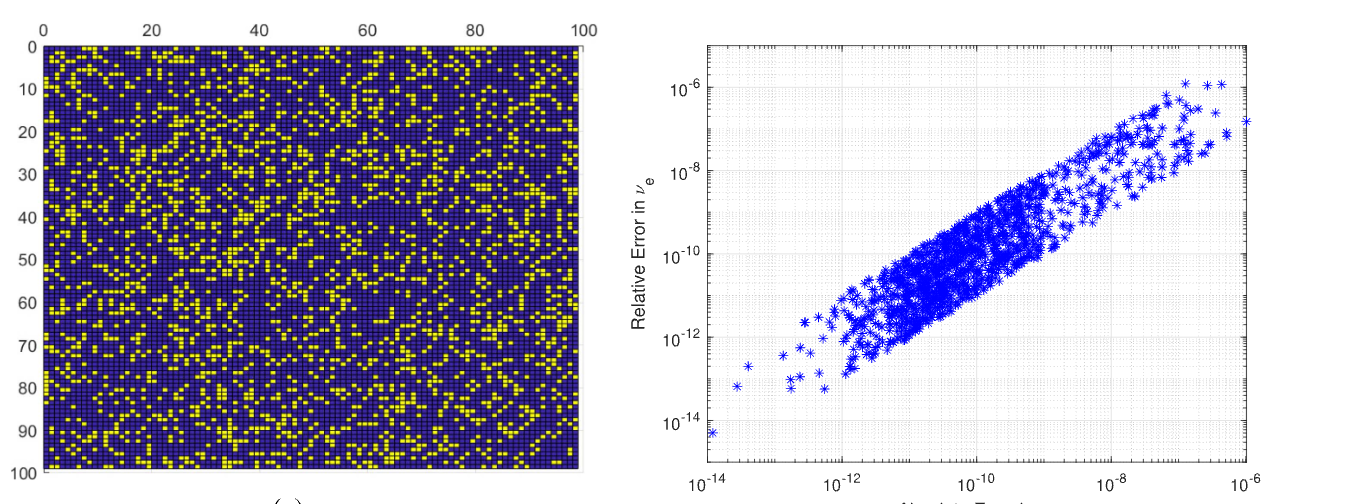
Optimization structure arising in network inference and cooperative control synthesis.
Representative Publications:
E. Michael, C. Manzie, T. A. Wood, D. Zelazo, and I. Shames, “Gradient Free Cooperative Seeking of a Moving Source,” Automatica, 152:110948, 2023.
@article{Michael2022a_J,
  author = {Michael, Elad and Manzie, Chris and Wood, Tony A. and Zelazo, Daniel and Shames, Iman},
  doi = {10.1016/j.automatica.2023.110948},
  journal = {Automatica},
  keyword = {journal},
  month = jun,
  number = {},
  pages = {110948},
  researchtopic = {optimization},
  title = {Gradient Free Cooperative Seeking of a Moving Source},
  url = {http://dx.doi.org/10.1016/j.automatica.2023.110948},
  volume = {152},
  year = {2023},
  pdf = {/Publications/Michael_AUT2023.pdf}
}
M. Sharf, I. Romm, M. Palman, D. Zelazo, and B. Cukurel, “Economic Dispatch of a Single Micro-Gas Turbine Under CHP Operation with Uncertain Demands,” Applied Energy, 309:118391, 2022.
@article{Sharf2021b_J,
  author = {Sharf, Miel and Romm, Iliya and Palman, M. and Zelazo, Daniel and Cukurel, Beni},
  doi = {10.1016/j.apenergy.2021.118391},
  journal = {Applied Energy},
  keyword = {journal},
  month = jan,
  number = {},
  pages = {118391},
  researchtopic = {energy, optimization},
  title = {Economic Dispatch of a Single Micro-Gas Turbine Under CHP Operation with Uncertain Demands},
  url = {http://dx.doi.org/10.1016/j.apenergy.2021.118391},
  volume = {309},
  year = {2022},
  pdf = {/Publications/Sharf_AE2022.pdf}
}
E. Michael, D. Zelazo, T. A. Wood, C. Manzie, and I. Shames, “Optimization with Networked Zeroth-Order Oracles,” in IEEE Conference on Decision and Control, Jeju Island, South Korea, Dec. 2020.
@inproceedings{Michael2020a,
  address = {Jeju Island, South Korea},
  author = {Michael, Elad and Zelazo, Daniel and Wood, Tony A. and Manzie, Chris and Shames, Iman},
  booktitle = {IEEE Conference on Decision and Control},
  doi = {10.1109/CDC42340.2020.9304272},
  keywords = {conference},
  month = dec,
  pages = {5354--5359},
  researchtopic = {optimization},
  title = {{Optimization with Networked Zeroth-Order Oracles}},
  url = {https://ieeexplore.ieee.org/document/9304272},
  year = {2020},
  pdf = {/Publications/Michael_CDC2020.pdf}
}
M. Sharf and D. Zelazo, “Analysis and Synthesis of MIMO Multi-Agent Systems Using Network Optimization,” IEEE Transactions on Automatic Control, 64(11):1558–2523, 2019.
@article{Sharf2017b_J,
  author = {Sharf, Miel and Zelazo, Daniel},
  doi = {10.1109/tac.2019.2908258},
  journal = {IEEE Transactions on Automatic Control},
  keyword = {journal},
  month = nov,
  number = {11},
  pages = {1558--2523},
  researchtopic = {nds, passivity, optimization, nonlinearcontrol},
  title = {Analysis and Synthesis of MIMO Multi-Agent Systems Using Network Optimization},
  url = {http://dx.doi.org/10.1109/tac.2019.2908258},
  volume = {64},
  year = {2019},
  pdf = {/Publications/Sharf_TAC2019.pdf}
}
M. Sharf and D. Zelazo, “Symmetry-Induced Clustering in Multi-Agent Systems using Network Optimization and Passivity,” in 27th Mediterranean Conference on Control and Automation, Akko, Israel, Jul. 2019.
@inproceedings{Sharf2019a,
  address = {Akko, Israel},
  author = {Sharf, Miel and Zelazo, Daniel},
  booktitle = {27th Mediterranean Conference on Control and Automation},
  doi = {10.1109/med.2019.8798507},
  keywords = {conference},
  month = jul,
  pages = {13--18},
  researchtopic = {nds, passivity, optimization},
  title = {{Symmetry-Induced Clustering in Multi-Agent Systems using Network Optimization and Passivity}},
  url = {http://dx.doi.org/10.1109/med.2019.8798507},
  year = {2019},
  slides = {/Talks/MED2019_Sharf.pdf},
  pdf = {/Publications/Sharf_MED19.pdf}
}
A. Jain, M. Sharf, and D. Zelazo, “Regularization and Feedback Passivation in Cooperative Control of Passivity-Short Systems: A Network Optimization Perspective,” IEEE Control Systems Letters, 2(4):731–736, 2018.
@article{Jain2018a_J,
  author = {Jain, Anoop and Sharf, Miel and Zelazo, Daniel},
  doi = {10.1109/lcsys.2018.2847738},
  journal = {IEEE Control Systems Letters},
  keyword = {journal},
  month = jul,
  number = {4},
  pages = {731--736},
  researchtopic = {passivity, nonlinearcontrol, nds, optimization},
  title = {Regularization and Feedback Passivation in Cooperative Control of Passivity-Short Systems: A Network Optimization Perspective},
  url = {http://dx.doi.org/10.1109/lcsys.2018.2847738},
  volume = {2},
  year = {2018},
  pdf = {/Publications/Jain_LCSS2018.pdf}
}
M. Sharf and D. Zelazo, “A Network Optimization Approach to Cooperative Control Synthesis,” IEEE Control Systems Letters, 1(1):86–91, 2017.
@article{Sharf2017a_J,
  author = {Sharf, Miel and Zelazo, Daniel},
  doi = {10.1109/lcsys.2017.2706948},
  journal = {IEEE Control Systems Letters},
  month = jul,
  number = {1},
  pages = {86--91},
  researchtopic = {nds, optimization, nonlinearcontrol, passivity},
  title = {A Network Optimization Approach to Cooperative Control Synthesis},
  url = {http://dx.doi.org/10.1109/lcsys.2017.2706948},
  volume = {1},
  year = {2017},
  pdf = {/Publications/Sharf_LCSS2017.pdf}
}
J. F. Rist, M. F. Dias, M. Palman, D. Zelazo, and B. Cukurel, “Economic Dispatch of a Single Micro-Gas Turbine Under CHP Operation,” Applied Energy, 200:1–18, 2017.
@article{Rist2016_J,
  author = {Rist, {J. F.} and Dias, {M. F.} and Palman, M. and Zelazo, Daniel and Cukurel, Beni},
  doi = {10.1016/j.apenergy.2017.05.064},
  journal = {Applied Energy},
  month = may,
  number = {},
  pages = {1--18},
  researchtopic = {energy, optimization},
  title = {Economic Dispatch of a Single Micro-Gas Turbine Under CHP Operation},
  url = {http://dx.doi.org/10.1016/j.apenergy.2017.05.064},
  volume = {200},
  year = {2017},
  pdf = {/Publications/Rist_AE2017.pdf}
}
Complete Related Publications
Related Publications:
E. Michael, C. Manzie, T. A. Wood, D. Zelazo, and I. Shames, “Gradient Free Cooperative Seeking of a Moving Source,” Automatica, 152:110948, 2023.
@article{Michael2022a_J,
  author = {Michael, Elad and Manzie, Chris and Wood, Tony A. and Zelazo, Daniel and Shames, Iman},
  doi = {10.1016/j.automatica.2023.110948},
  journal = {Automatica},
  keyword = {journal},
  month = jun,
  number = {},
  pages = {110948},
  researchtopic = {optimization},
  title = {Gradient Free Cooperative Seeking of a Moving Source},
  url = {http://dx.doi.org/10.1016/j.automatica.2023.110948},
  volume = {152},
  year = {2023},
  pdf = {/Publications/Michael_AUT2023.pdf}
}
M. Sharf, I. Romm, M. Palman, D. Zelazo, and B. Cukurel, “Economic Dispatch of a Single Micro-Gas Turbine Under CHP Operation with Uncertain Demands,” Applied Energy, 309:118391, 2022.
@article{Sharf2021b_J,
  author = {Sharf, Miel and Romm, Iliya and Palman, M. and Zelazo, Daniel and Cukurel, Beni},
  doi = {10.1016/j.apenergy.2021.118391},
  journal = {Applied Energy},
  keyword = {journal},
  month = jan,
  number = {},
  pages = {118391},
  researchtopic = {energy, optimization},
  title = {Economic Dispatch of a Single Micro-Gas Turbine Under CHP Operation with Uncertain Demands},
  url = {http://dx.doi.org/10.1016/j.apenergy.2021.118391},
  volume = {309},
  year = {2022},
  pdf = {/Publications/Sharf_AE2022.pdf}
}
N. Peleg, “Economic Dispatch for a Network of Micro-Gas Turbines,” mastersthesis, Technion - Israel Institute of Technology, Aerospace Engineering Department, 2022.
@thesis{Peleg2022,
  author = {Peleg, Nethanel},
  title = {Economic Dispatch for a Network of Micro-Gas Turbines},
  school = {Technion - Israel Institute of Technology, Aerospace Engineering Department},
  year = {2022},
  type = {mastersthesis},
  researchtopic = {thesis, energy, optimization},
  pdf = {/Theses/Thesis_Peleg.pdf}
}
E. Michael, D. Zelazo, T. A. Wood, C. Manzie, and I. Shames, “Optimization with Networked Zeroth-Order Oracles,” in IEEE Conference on Decision and Control, Jeju Island, South Korea, Dec. 2020.
@inproceedings{Michael2020a,
  address = {Jeju Island, South Korea},
  author = {Michael, Elad and Zelazo, Daniel and Wood, Tony A. and Manzie, Chris and Shames, Iman},
  booktitle = {IEEE Conference on Decision and Control},
  doi = {10.1109/CDC42340.2020.9304272},
  keywords = {conference},
  month = dec,
  pages = {5354--5359},
  researchtopic = {optimization},
  title = {{Optimization with Networked Zeroth-Order Oracles}},
  url = {https://ieeexplore.ieee.org/document/9304272},
  year = {2020},
  pdf = {/Publications/Michael_CDC2020.pdf}
}
M. Sharf, “Network Optimization Methods in Passivity-Based Cooperative Control,” phdthesis, Technion - Israel Institute of Technology, Aerospace Engineering Department, 2020.
@thesis{Sharf2020,
  author = {Sharf, Miel},
  title = {Network Optimization Methods in Passivity-Based Cooperative Control},
  school = {Technion - Israel Institute of Technology, Aerospace Engineering Department},
  year = {2020},
  type = {phdthesis},
  researchtopic = {thesis, nds, optimization, passivity},
  pdf = {/Theses/Thesis_Sharf.pdf}
}
T. Ikeda, D. Zelazo, and K. Kashima, “Maximum Hands-Off Distributed Bearing-Based Formation Control,” in IEEE Conference on Decision and Control, Nice, France, Dec. 2019.
@inproceedings{Ikeda2019a,
  address = {Nice, France},
  author = {Ikeda, Takuya and Zelazo, Daniel and Kashima, Kenji},
  booktitle = {IEEE Conference on Decision and Control},
  doi = {10.1109/cdc40024.2019.9029574},
  keywords = {conference},
  month = dec,
  pages = {4459--4464},
  researchtopic = {formationcontrol, optimization},
  title = {{Maximum Hands-Off Distributed Bearing-Based Formation Control}},
  url = {http://dx.doi.org/10.1109/cdc40024.2019.9029574},
  year = {2019},
  pdf = {/Publications/Ikeda_CDC19.pdf}
}
M. Sharf and D. Zelazo, “Analysis and Synthesis of MIMO Multi-Agent Systems Using Network Optimization,” IEEE Transactions on Automatic Control, 64(11):1558–2523, 2019.
@article{Sharf2017b_J,
  author = {Sharf, Miel and Zelazo, Daniel},
  doi = {10.1109/tac.2019.2908258},
  journal = {IEEE Transactions on Automatic Control},
  keyword = {journal},
  month = nov,
  number = {11},
  pages = {1558--2523},
  researchtopic = {nds, passivity, optimization, nonlinearcontrol},
  title = {Analysis and Synthesis of MIMO Multi-Agent Systems Using Network Optimization},
  url = {http://dx.doi.org/10.1109/tac.2019.2908258},
  volume = {64},
  year = {2019},
  pdf = {/Publications/Sharf_TAC2019.pdf}
}
M. Sharf and D. Zelazo, “Symmetry-Induced Clustering in Multi-Agent Systems using Network Optimization and Passivity,” in 27th Mediterranean Conference on Control and Automation, Akko, Israel, Jul. 2019.
@inproceedings{Sharf2019a,
  address = {Akko, Israel},
  author = {Sharf, Miel and Zelazo, Daniel},
  booktitle = {27th Mediterranean Conference on Control and Automation},
  doi = {10.1109/med.2019.8798507},
  keywords = {conference},
  month = jul,
  pages = {13--18},
  researchtopic = {nds, passivity, optimization},
  title = {{Symmetry-Induced Clustering in Multi-Agent Systems using Network Optimization and Passivity}},
  url = {http://dx.doi.org/10.1109/med.2019.8798507},
  year = {2019},
  slides = {/Talks/MED2019_Sharf.pdf},
  pdf = {/Publications/Sharf_MED19.pdf}
}
A. Jain, M. Sharf, and D. Zelazo, “Regularization and Feedback Passivation in Cooperative Control of Passivity-Short Systems: A Network Optimization Perspective,” IEEE Control Systems Letters, 2(4):731–736, 2018.
@article{Jain2018a_J,
  author = {Jain, Anoop and Sharf, Miel and Zelazo, Daniel},
  doi = {10.1109/lcsys.2018.2847738},
  journal = {IEEE Control Systems Letters},
  keyword = {journal},
  month = jul,
  number = {4},
  pages = {731--736},
  researchtopic = {passivity, nonlinearcontrol, nds, optimization},
  title = {Regularization and Feedback Passivation in Cooperative Control of Passivity-Short Systems: A Network Optimization Perspective},
  url = {http://dx.doi.org/10.1109/lcsys.2018.2847738},
  volume = {2},
  year = {2018},
  pdf = {/Publications/Jain_LCSS2018.pdf}
}
M. Sharf and D. Zelazo, “A Network Optimization Approach to Cooperative Control Synthesis,” IEEE Control Systems Letters, 1(1):86–91, 2017.
@article{Sharf2017a_J,
  author = {Sharf, Miel and Zelazo, Daniel},
  doi = {10.1109/lcsys.2017.2706948},
  journal = {IEEE Control Systems Letters},
  month = jul,
  number = {1},
  pages = {86--91},
  researchtopic = {nds, optimization, nonlinearcontrol, passivity},
  title = {A Network Optimization Approach to Cooperative Control Synthesis},
  url = {http://dx.doi.org/10.1109/lcsys.2017.2706948},
  volume = {1},
  year = {2017},
  pdf = {/Publications/Sharf_LCSS2017.pdf}
}
J. F. Rist, M. F. Dias, M. Palman, D. Zelazo, and B. Cukurel, “Economic Dispatch of a Single Micro-Gas Turbine Under CHP Operation,” Applied Energy, 200:1–18, 2017.
@article{Rist2016_J,
  author = {Rist, {J. F.} and Dias, {M. F.} and Palman, M. and Zelazo, Daniel and Cukurel, Beni},
  doi = {10.1016/j.apenergy.2017.05.064},
  journal = {Applied Energy},
  month = may,
  number = {},
  pages = {1--18},
  researchtopic = {energy, optimization},
  title = {Economic Dispatch of a Single Micro-Gas Turbine Under CHP Operation},
  url = {http://dx.doi.org/10.1016/j.apenergy.2017.05.064},
  volume = {200},
  year = {2017},
  pdf = {/Publications/Rist_AE2017.pdf}
}
M. Sharf and D. Zelazo, “On Certain Properties of Convex Functions,” Mar. 2017.
@techreport{Sharf2017arxiv,
  author = {{Sharf}, M. and {Zelazo}, D.},
  title = {{On Certain Properties of Convex Functions}},
  journal = {ArXiv e-prints},
  archiveprefix = {arXiv},
  eprint = {1703.00867},
  arxiv = {https://arxiv.org/abs/1703.00867},
  keywords = {letter},
  year = {2017},
  month = mar,
  researchtopic = {optimization},
  pdf = {/Publications/Sharf_2017arxiv.pdf}
}
Y. Ben Shoushan and D. Zelazo, “Negotiation Between Dynamical Systems with Connectivity Constraints,” in 57th Israel Annual Conference on Aerospace Sciences , Tel-Aviv, Israel, Feb. 2017.
@inproceedings{Shoushan2017,
  address = {Tel-Aviv, Israel},
  author = {{Ben Shoushan}, Y and Zelazo, D},
  booktitle = {57th Israel Annual Conference on Aerospace Sciences },
  keywords = {conference},
  month = feb,
  pages = {},
  researchtopic = {nds, optimization},
  title = {Negotiation Between Dynamical Systems with Connectivity Constraints},
  pdf = {/Publications/Shoushan_IACAS2017.pdf},
  year = {2017}
}
Y. Ben-Shoushan, “Negotiation between Dynamical Systems with Connectivity Constraints,” mastersthesis, Technion - Israel Institute of Technology, Aerospace Engineering Department, 2017.
@thesis{BenShoushan2017,
  author = {Ben-Shoushan, Yaniv},
  title = {Negotiation between Dynamical Systems with Connectivity Constraints},
  school = {Technion - Israel Institute of Technology, Aerospace Engineering Department},
  year = {2017},
  type = {mastersthesis},
  researchtopic = {thesis, nds, optimization},
  pdf = {/Theses/Thesis_BenShoushan.pdf}
}
M. Bürger, D. Zelazo, and F. Allgöwer, “On the Steady-State Inverse-Optimality of Passivity-Based Cooperative Control,” in 4th IFAC Workshop on Distributed Estimation and Control in Networked System, Koblenz, Germany, Sep. 2013.
@inproceedings{Mathias2013,
  address = {Koblenz, Germany},
  author = {B\"{u}rger, Mathias and Zelazo, Daniel and Allg\"{o}wer, Frank},
  booktitle = {4th IFAC Workshop on Distributed Estimation and Control in Networked System},
  doi = {10.3182/20130925-2-DE-4044.00004},
  editor = {Daniel, Vey},
  keywords = {conference},
  month = sep,
  pages = {138--143},
  researchtopic = {nds, passivity, nonlinearcontrol, optimization},
  title = {{On the Steady-State Inverse-Optimality of Passivity-Based Cooperative Control}},
  url = {http://www.ifac-papersonline.net/Detailed/62351.html},
  year = {2013},
  pdf = {/Publications/Burger_NecSys13.pdf}
}
S. Schuler, D. Zelazo, and F. Allgöwer, “Robust Design of Sparse Relative Sensing Networks,” in European Control Conference, Zürich, Switzerland, Jul. 2013.
@inproceedings{Schuler2013,
  address = {Z\"{u}rich, Switzerland},
  author = {Schuler, Simone and Zelazo, Daniel and Allg\"{o}wer, F},
  booktitle = {European Control Conference},
  doi = {10.23919/ecc.2013.6669618},
  keywords = {conference},
  pages = {1860--1865},
  researchtopic = {nds, optimization},
  title = {{Robust Design of Sparse Relative Sensing Networks}},
  url = {http://dx.doi.org/10.23919/ecc.2013.6669618},
  year = {2013},
  month = jul,
  slides = {/Talks/2013_ECC_robust_RSN_design.pdf},
  pdf = {/Publications/Schuler_ECC13.pdf}
}
M. Bürger, D. Zelazo, and F. Allgöwer, “Hierarchical Clustering of Dynamical Networks Using a Saddle-Point Analysis,” IEEE Transactions on Automatic Control, 58(1):113–124, 2013.
@article{Burger2011_J,
  author = {B\"{u}rger, Mathias and Zelazo, Daniel and Allg\"{o}wer, Frank},
  doi = {10.1109/TAC.2012.2206695},
  issn = {0018-9286},
  journal = {IEEE Transactions on Automatic Control},
  month = jan,
  number = {1},
  pages = {113--124},
  researchtopic = {nds, optimization},
  title = {{Hierarchical Clustering of Dynamical Networks Using a Saddle-Point Analysis}},
  url = {http://ieeexplore.ieee.org/lpdocs/epic03/wrapper.htm?arnumber=6228512},
  volume = {58},
  year = {2013},
  pdf = {/Publications/Burger_TAC2013.pdf}
}
D. Zelazo, M. Bürger, and F. Allgöwer, “A Finite-Time Dual Method for Negotiation between Dynamical Systems,” SIAM Journal on Control and Optimization, 51(1):172–194, 2013.
@article{Zelazo2013_J,
  author = {Zelazo, Daniel and B\"{u}rger, Mathias and Allg\"{o}wer, Frank},
  doi = {10.1137/100819175},
  issn = {0363-0129},
  journal = {SIAM Journal on Control and Optimization},
  keywords = {distributed optimization,finite-time consensus,multiagent systems,subgradient},
  month = jan,
  number = {1},
  pages = {172--194},
  researchtopic = {optimization},
  title = {{A Finite-Time Dual Method for Negotiation between Dynamical Systems}},
  url = {http://epubs.siam.org/doi/abs/10.1137/100819175},
  volume = {51},
  year = {2013},
  pdf = {/Publications/Zelazo_SIAMJCO2013.pdf}
}
D. Zelazo, M. Bürger, and F. Allgöwer, “Dynamic Negotiation Under Switching Communication,” in Mathematical System Theory – Festschrift in Honor of Uwe Helmke on the Occasion of his Sixtieth Birthday, K. Hüper and J. Trumpf, Eds. CreateSpace, 2013, p. 479500.
@incollection{Zelazo2012b,
  author = {Zelazo, Daniel and B\"{u}rger, Mathias and Allg\"{o}wer, Frank},
  booktitle = {Mathematical System Theory -- Festschrift in Honor of Uwe Helmke on the Occasion of his Sixtieth Birthday},
  editor = {H\"{u}per, K and Trumpf, J},
  file = {:Users/danielzelazo/Dropbox/Research/Mendeley Paper Database/Zelazo, B\"{u}rger, Allg\"{o}wer/Mathematical System Theory -- Festschrift in Honor of Uwe Helmke on the Occasion of his Sixtieth Birthday/Zelazo, B\"{u}rger, Allg\"{o}wer - 2013 - Dynamic Negotiation Under Switching Communication.pdf:pdf},
  isbn = {978-1470044008},
  pages = {479----500},
  publisher = {CreateSpace},
  title = {{Dynamic Negotiation Under Switching Communication}},
  url = {http://users.cecs.anu.edu.au/~trumpf/UH60Festschrift.pdf},
  year = {2013},
  researchtopic = {optimization}
}
S. Schuler, D. Zelazo, and F. Allgöwer, “Design of sparse relative sensing networks,” in 51st IEEE Conference on Decision and Control, Maui, HI, Dec. 2012.
@inproceedings{Schuler2012,
  address = {Maui, HI},
  author = {Schuler, Simone and Zelazo, Daniel and Allg\"{o}wer, Frank},
  booktitle = {51st IEEE Conference on Decision and Control},
  doi = {10.1109/CDC.2012.6426358},
  isbn = {978-1-4673-2066-5},
  keywords = {conference},
  month = dec,
  pages = {2749--2754},
  researchtopic = {nds, optimization},
  title = {{Design of sparse relative sensing networks}},
  url = {http://ieeexplore.ieee.org/lpdocs/epic03/wrapper.htm?arnumber=6426358},
  year = {2012},
  pdf = {/Publications/Schuler_CDC12.pdf},
  slides = {/Talks/CDC2012_Schuler.pdf}
}
M. Bürger, D. Zelazo, and F. Allgöwer, “Combinatorial Insights and Robustness Analysis for Clustering in Dynamic Networks,” in American Control Conference, Montreal, Canada, Jul. 2012.
@inproceedings{Burger2012,
  address = {Montreal, Canada},
  author = {B\"{u}rger, Matthias and Zelazo, Daniel and Allg\"{o}wer, Frank},
  booktitle = {American Control Conference},
  doi = {10.1109/acc.2012.6314935},
  keywords = {conference},
  pages = {454--459},
  researchtopic = {nds, optimization},
  title = {{Combinatorial Insights and Robustness Analysis for Clustering in Dynamic Networks}},
  url = {http://dx.doi.org/10.1109/acc.2012.6314935},
  year = {2012},
  month = jul,
  pdf = {/Publications/Burger_ACC12.pdf}
}
D. Zelazo, R. Dai, and M. Mesbahi, “An energy management system for off-grid power systems,” Energy Systems, 3(2):153–179, 2012.
@article{Zelazo2011a_J,
  author = {Zelazo, Daniel and Dai, Ran and Mesbahi, Mehran},
  doi = {10.1007/s12667-012-0050-4},
  issn = {1868-3967},
  journal = {Energy Systems},
  month = jan,
  number = {2},
  pages = {153--179},
  researchtopic = {energy, optimization},
  title = {{An energy management system for off-grid power systems}},
  url = {http://www.springerlink.com/index/10.1007/s12667-012-0050-4},
  volume = {3},
  year = {2012},
  pdf = {/Publications/Zelazo_ESys2012.pdf}
}
D. Zelazo, S. Schuler, and F. Allgöwer, “Cycles and Sparse Design of Consensus Networks,” in 51st IEEE Conference on Decision and Control, Maui, HI, 2012.
@inproceedings{Zelazo2012d,
  address = {Maui, HI},
  author = {Zelazo, Daniel and Schuler, Simone and Allg\"{o}wer, Frank},
  booktitle = {51st IEEE Conference on Decision and Control},
  doi = {10.1109/cdc.2012.6426450},
  keywords = {conference},
  pages = {3803--3813},
  researchtopic = {nds, optimization},
  title = {{Cycles and Sparse Design of Consensus Networks}},
  url = {http://dx.doi.org/10.1109/cdc.2012.6426450},
  year = {2012},
  pdf = {/Publications/Zelazo_CDC12_b.pdf},
  slides = {/Talks/CDC2012_Zelazo_b.pdf}
}
M. Bürger, D. Zelazo, and F. Allgöwer, “Network clustering: A dynamical systems and saddle-point perspective,” in 50th IEEE Conference on Decision and Control and European Control Conference, Orlando, FL, Dec. 2011.
@inproceedings{Zelazo2011b,
  address = {Orlando, FL},
  author = {B\"{u}rger, Mathias and Zelazo, Daniel and Allg\"{o}wer, Frank},
  booktitle = {50th IEEE Conference on Decision and Control and European Control Conference},
  doi = {10.1109/CDC.2011.6161045},
  file = {:Users/danielzelazo/Dropbox/Research/Mendeley Paper Database/B\"{u}rger, Zelazo, Allg\"{o}wer/IEEE Conference on Decision and Control and European Control Conference/B\"{u}rger, Zelazo, Allg\"{o}wer - 2011 - Network clustering A dynamical systems and saddle-point perspective.pdf:pdf},
  isbn = {978-1-61284-801-3},
  keywords = {conference},
  month = dec,
  pages = {7825--7830},
  researchtopic = {nds, optimization},
  title = {{Network clustering: A dynamical systems and saddle-point perspective}},
  url = {http://ieeexplore.ieee.org/lpdocs/epic03/wrapper.htm?arnumber=6161045},
  year = {2011},
  pdf = {/Publications/Burger_CDC11.pdf}
}
D. Zelazo, M. Bürger, and F. Allgöwer, “A Distributed Real-Time Algorithm for Preference-Based Agreement,” in Proc. 18th IFAC World Congress, Milan, Italy, Aug. 2011.
@inproceedings{Zelazo2011,
  address = {Milan, Italy},
  author = {Zelazo, Daniel and B\"{u}rger, Mathias and Allg\"{o}wer, Frank},
  booktitle = {Proc. 18th IFAC World Congress},
  doi = {10.3182/20110828-6-IT-1002.03155},
  editor = {Sergio, Bittanti},
  keywords = {conference},
  month = aug,
  pages = {8933--8938},
  researchtopic = {nds, optimization},
  title = {{A Distributed Real-Time Algorithm for Preference-Based Agreement}},
  url = {http://www.ifac-papersonline.net/Detailed/50415.html},
  year = {2011},
  pdf = {/Publications/Zelazo_IFAC11.pdf}
}