Passivity is an energy-based property that is especially useful for interconnected and nonlinear systems. Because passive systems preserve stability under broad classes of interconnections, passivity provides a constructive way to move between component-level properties and network-level guarantees.
Our work uses passivity both as an analysis tool and as a synthesis tool. A recurring theme is the connection between passivity, monotonicity, convex network optimization, cooperative control of systems that are not passive before feedback design, and newer geometric notions of dissipativity relative to target manifolds.
Passivity, Duality, and Network Optimization
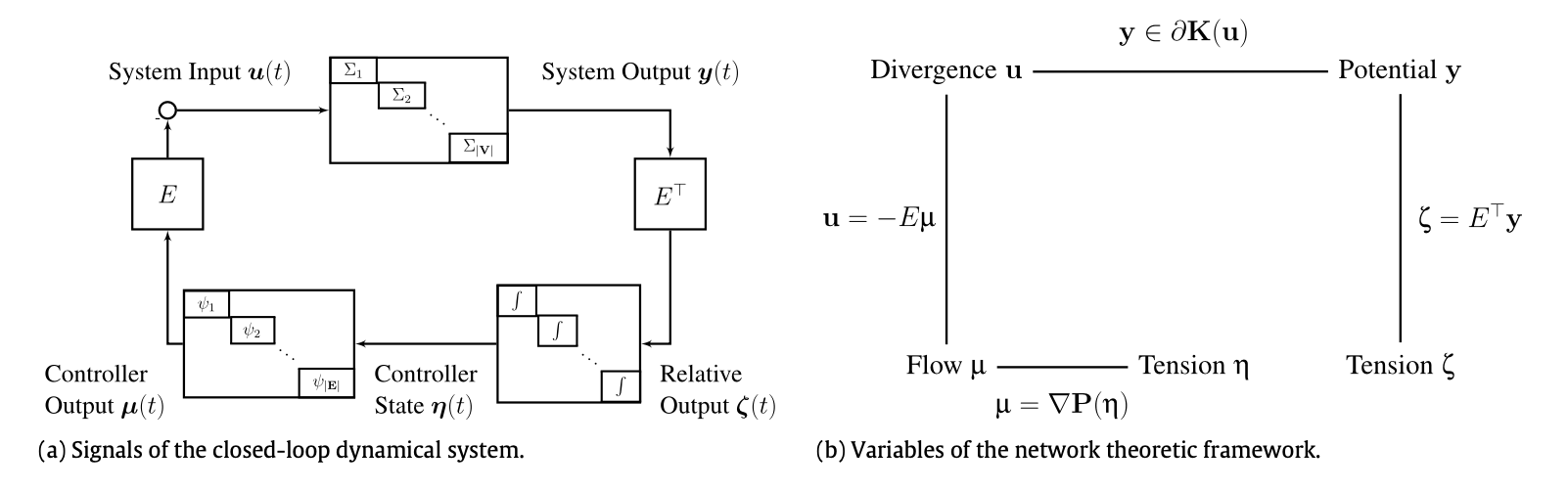
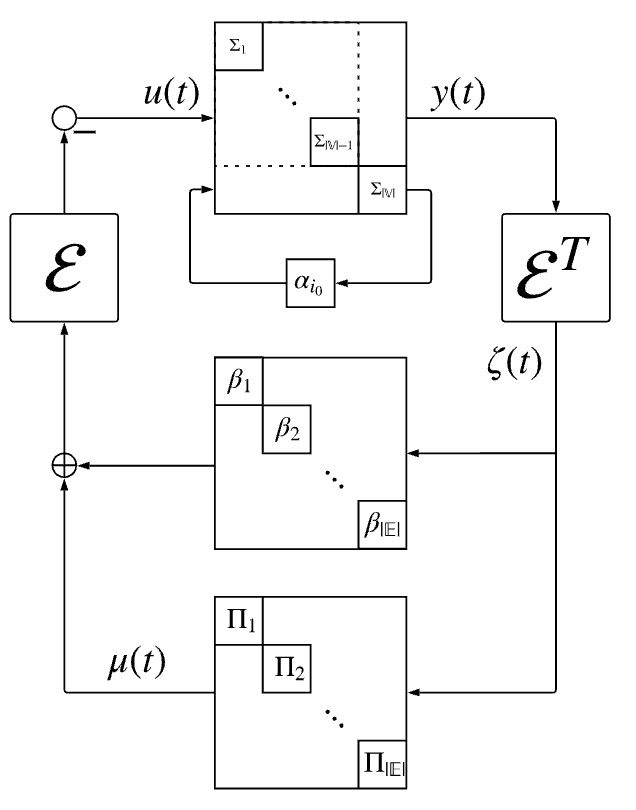
Passivity-based cooperative control can be interpreted through the lens of network optimization. This viewpoint reveals a duality between diffusive interconnections and optimization constraints, and it explains why steady-state behavior in passive networks often solves an implicit optimization problem.
These results connect edge agreement, passivity analysis, inverse optimality, and distributed controller synthesis for networked systems.
Duality between diffusive network interconnections and optimization structure.
Representative Publications:
M. Sharf and D. Zelazo, “Analysis and Synthesis of MIMO Multi-Agent Systems Using Network Optimization,” IEEE Transactions on Automatic Control, 64(11):1558–2523, 2019.
@article{Sharf2017b_J,
  author = {Sharf, Miel and Zelazo, Daniel},
  doi = {10.1109/tac.2019.2908258},
  journal = {IEEE Transactions on Automatic Control},
  keyword = {journal},
  month = nov,
  number = {11},
  pages = {1558--2523},
  researchtopic = {nds, passivity, optimization, nonlinearcontrol},
  title = {Analysis and Synthesis of MIMO Multi-Agent Systems Using Network Optimization},
  url = {http://dx.doi.org/10.1109/tac.2019.2908258},
  volume = {64},
  year = {2019},
  pdf = {/Publications/Sharf_TAC2019.pdf}
}
M. Sharf and D. Zelazo, “A Network Optimization Approach to Cooperative Control Synthesis,” IEEE Control Systems Letters, 1(1):86–91, 2017.
@article{Sharf2017a_J,
  author = {Sharf, Miel and Zelazo, Daniel},
  doi = {10.1109/lcsys.2017.2706948},
  journal = {IEEE Control Systems Letters},
  month = jul,
  number = {1},
  pages = {86--91},
  researchtopic = {nds, optimization, nonlinearcontrol, passivity},
  title = {A Network Optimization Approach to Cooperative Control Synthesis},
  url = {http://dx.doi.org/10.1109/lcsys.2017.2706948},
  volume = {1},
  year = {2017},
  pdf = {/Publications/Sharf_LCSS2017.pdf}
}
M. Bürger, D. Zelazo, and F. Allgöwer, “Duality and network theory in passivity-based cooperative control,” Automatica, 50(8):2051–2061, 2014.
@article{Burger2014_J,
  author = {B\"{u}rger, Mathias and Zelazo, Daniel and Allg\"{o}wer, Frank},
  doi = {10.1016/j.automatica.2014.06.002},
  issn = {00051098},
  journal = {Automatica},
  month = aug,
  number = {8},
  pages = {2051--2061},
  researchtopic = {passivity, nonlinearcontrol},
  title = {{Duality and network theory in passivity-based cooperative control}},
  url = {http://linkinghub.elsevier.com/retrieve/pii/S0005109814002301},
  volume = {50},
  year = {2014},
  pdf = {/Publications/Burger_AUT2014.pdf}
}
M. Bürger, D. Zelazo, and F. Allgöwer, “On the Steady-State Inverse-Optimality of Passivity-Based Cooperative Control,” in 4th IFAC Workshop on Distributed Estimation and Control in Networked System, Koblenz, Germany, Sep. 2013.
@inproceedings{Mathias2013,
  address = {Koblenz, Germany},
  author = {B\"{u}rger, Mathias and Zelazo, Daniel and Allg\"{o}wer, Frank},
  booktitle = {4th IFAC Workshop on Distributed Estimation and Control in Networked System},
  doi = {10.3182/20130925-2-DE-4044.00004},
  editor = {Daniel, Vey},
  keywords = {conference},
  month = sep,
  pages = {138--143},
  researchtopic = {nds, passivity, nonlinearcontrol, optimization},
  title = {{On the Steady-State Inverse-Optimality of Passivity-Based Cooperative Control}},
  url = {http://www.ifac-papersonline.net/Detailed/62351.html},
  year = {2013},
  pdf = {/Publications/Burger_NecSys13.pdf}
}
D. Zelazo and M. Mesbahi, “Edge Agreement: Graph-Theoretic Performance Bounds and Passivity Analysis,” IEEE Transactions on Automatic Control, 56(3):544–555, 2011.
@article{Zelazo2009b_J,
  author = {Zelazo, Daniel and Mesbahi, Mehran},
  doi = {10.1109/TAC.2010.2056730},
  issn = {0018-9286},
  journal = {IEEE Transactions on Automatic Control},
  month = mar,
  number = {3},
  pages = {544--555},
  researchtopic = {nds, graphs, consensus, passivity},
  title = {{Edge Agreement: Graph-Theoretic Performance Bounds and Passivity Analysis}},
  url = {http://ieeexplore.ieee.org/lpdocs/epic03/wrapper.htm?arnumber=5504814},
  volume = {56},
  year = {2011},
  pdf = {/Publications/Zelazo_TAC2011.pdf}
}
Passivation of Passive-Short Systems
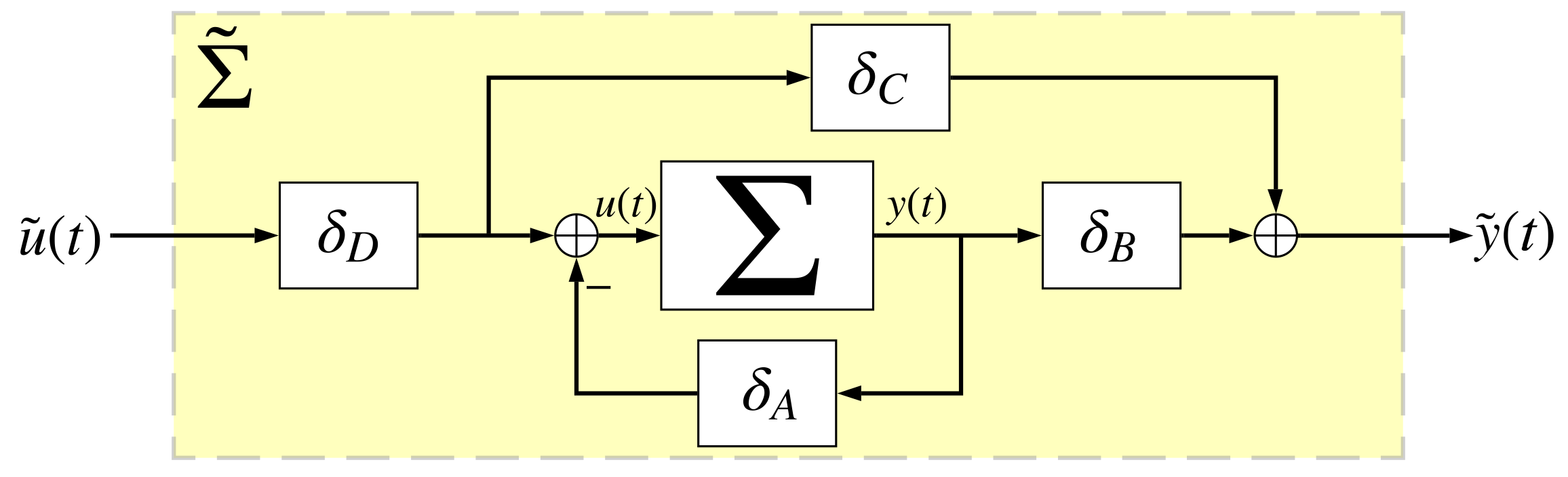
Many nonlinear systems are not passive with the inputs and outputs available to the controller. Passivation asks how to transform or regularize the input-output map so that the resulting closed-loop component can be safely interconnected with other agents.
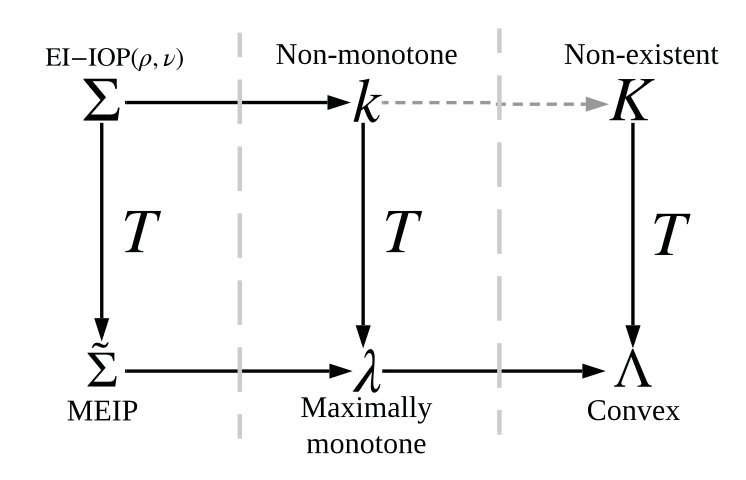
Our work develops geometric and optimization-based passivation methods for passive-short systems, including characterizations of passivizing input-output transformations for SISO and MIMO nonlinear systems.
Passivation through geometric, monotonicity, and convexity-based transformations.
Representative Publications:
M. Sharf and D. Zelazo, “A Characterization of Passivizing Input-Output Transformations of Nonlinear MIMO Systems,” IEEE Control Systems Letters, 8:2733–2738, 2024.
@article{Sharf2024_J,
  author = {Sharf, Miel and Zelazo, Daniel},
  doi = {10.1109/LCSYS.2024.3513238},
  journal = {IEEE Control Systems Letters},
  month = dec,
  number = {},
  pages = {2733-2738},
  researchtopic = {passivity, nonlinearcontrol},
  title = {A Characterization of Passivizing Input-Output Transformations of Nonlinear MIMO Systems},
  url = {https://ieeexplore.ieee.org/document/10783036},
  volume = {8},
  year = {2024},
  pdf = {/Publications/Sharf_LCSS2024.pdf}
}
M. Sharf and D. Zelazo, “A Characterization of All Linear Passivizing Input-Output Transformations of a Passive-Short System: The SISO Case,” IEEE Control Systems Letters, 8:532–537, 2024.
@article{Sharf2021c_J,
  author = {Sharf, Miel and Zelazo, Daniel},
  doi = {10.1109/LCSYS.2024.3396616},
  journal = {IEEE Control Systems Letters},
  month = may,
  number = {},
  pages = {532--537},
  researchtopic = {passivity, nonlinearcontrol},
  title = {A Characterization of All Linear Passivizing Input-Output Transformations of a Passive-Short System: The SISO Case},
  url = {https://ieeexplore.ieee.org/document/10518141},
  volume = {8},
  year = {2024},
  pdf = {/Publications/Sharf_LCSS2024b.pdf},
  slides = {/Talks/CDC2024_Zelazo.pdf}
}
M. Sharf, A. Jain, and D. Zelazo, “Geometric Method for Passivation and Cooperative Control of Equilibrium-Independent Passive-Short Systems,” IEEE Transactions on Automatic Control, 66(12):5877–5892, 2021.
@article{Sharf2019c_J,
  author = {Sharf, Miel and Jain, Anoop and Zelazo, Daniel},
  doi = {10.1109/tac.2020.3043390},
  journal = {IEEE Transactions on Automatic Control},
  keyword = {journal},
  month = dec,
  number = {12},
  pages = {5877--5892},
  researchtopic = {passivity, nonlinearcontrol, nds},
  title = {Geometric Method for Passivation and Cooperative Control of Equilibrium-Independent Passive-Short Systems},
  url = {http://dx.doi.org/10.1109/tac.2020.3043390},
  volume = {66},
  year = {2021},
  pdf = {/Publications/Sharf_TAC2021.pdf}
}
M. Sharf, “Network Optimization Methods in Passivity-Based Cooperative Control,” phdthesis, Technion - Israel Institute of Technology, Aerospace Engineering Department, 2020.
@thesis{Sharf2020,
  author = {Sharf, Miel},
  title = {Network Optimization Methods in Passivity-Based Cooperative Control},
  school = {Technion - Israel Institute of Technology, Aerospace Engineering Department},
  year = {2020},
  type = {phdthesis},
  researchtopic = {thesis, nds, optimization, passivity},
  pdf = {/Theses/Thesis_Sharf.pdf}
}
M. Sharf and D. Zelazo, “Network Feedback Passivation of Passivity-Short Multi-Agent Systems,” IEEE Control Systems Letters, 3(3):607–612, 2019.
@article{Sharf2019a_J,
  author = {Sharf, Miel and Zelazo, Daniel},
  doi = {10.1109/lcsys.2019.2914128},
  journal = {IEEE Control Systems Letters},
  keyword = {journal},
  month = jul,
  number = {3},
  pages = {607--612},
  researchtopic = {passivity, nonlinearcontrol, nds},
  title = {Network Feedback Passivation of Passivity-Short Multi-Agent Systems},
  url = {http://dx.doi.org/10.1109/lcsys.2019.2914128},
  volume = {3},
  year = {2019},
  pdf = {/Publications/Sharf_LCSS2019.pdf},
  slides = {/Talks/Sharf_CDC2019.pdf}
}
A. Jain, M. Sharf, and D. Zelazo, “Regularization and Feedback Passivation in Cooperative Control of Passivity-Short Systems: A Network Optimization Perspective,” IEEE Control Systems Letters, 2(4):731–736, 2018.
@article{Jain2018a_J,
  author = {Jain, Anoop and Sharf, Miel and Zelazo, Daniel},
  doi = {10.1109/lcsys.2018.2847738},
  journal = {IEEE Control Systems Letters},
  keyword = {journal},
  month = jul,
  number = {4},
  pages = {731--736},
  researchtopic = {passivity, nonlinearcontrol, nds, optimization},
  title = {Regularization and Feedback Passivation in Cooperative Control of Passivity-Short Systems: A Network Optimization Perspective},
  url = {http://dx.doi.org/10.1109/lcsys.2018.2847738},
  volume = {2},
  year = {2018},
  pdf = {/Publications/Jain_LCSS2018.pdf}
}
Transversal and Geometric Passivity
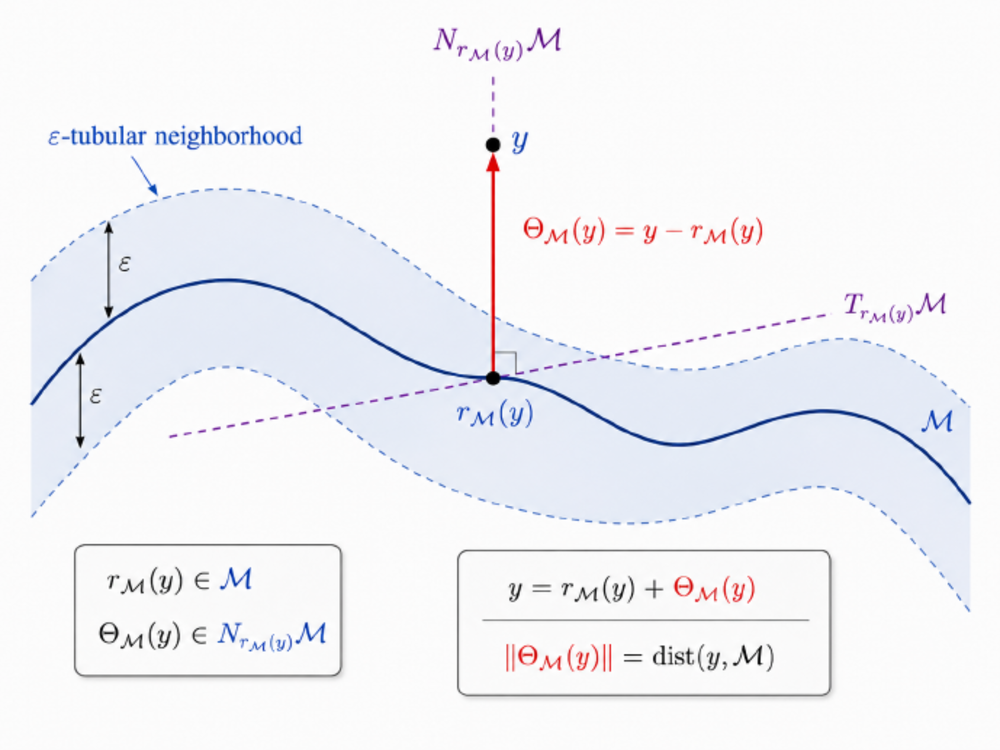
Classical passivity usually measures energy exchange relative to an equilibrium, a shifted equilibrium, or a pair of trajectories. Transversal passivity changes the reference object: the target can be a manifold, orbit, agreement set, or other geometric constraint, and the dissipation certificate only penalizes motion transverse to that target.
Our ongoing work develops this geometric viewpoint for interconnected systems. The central objects are manifold error maps, tubular retractions, and compatibility conditions that allow feedback interconnections to preserve transverse dissipativity. This gives a passivity framework for behaviors such as agreement, synchronization, and limit-cycle regulation, where motion along the target set should remain free.
Geometric passivity uses manifold error maps to measure the transverse distance to a target set.
Passivity also gives tools for analyzing nonlinear consensus, orientation effects in directed networks, and data-driven questions such as network identification. In these problems, the passivity property acts as a bridge between local nonlinear dynamics and global graph-dependent behavior.
This direction connects passivity analysis on digraphs, network feedback passivation, and passivity-based methods for recovering network structure.
Network feedback passivation for cooperative control of passive-short agents.
Representative Publications:
F. Yue and D. Zelazo, “A Passivity Analysis for Nonlinear Consensus on Digraphs,” in 64th IEEE Conference on Decision and Control, Rio de Janerio, Brazil, Dec. 2025.
@inproceedings{Yue2025_CDC,
  address = {Rio de Janerio, Brazil},
  author = {Yue, Fengyu and Zelazo, Daniel},
  booktitle = {64th IEEE Conference on Decision and Control},
  researchtopic = {passivity, nonlinearcontrol, nds, consensus},
  title = {A Passivity Analysis for Nonlinear Consensus on Digraphs},
  year = {2025},
  pages = {6216--6221},
  month = dec,
  pdf = {/Publications/YUE_CDC25.pdf},
  slides = {/Talks/CDC2025_Yue.pdf}
}
M. Sharf and D. Zelazo, “Symmetry-Induced Clustering in Multi-Agent Systems using Network Optimization and Passivity,” in 27th Mediterranean Conference on Control and Automation, Akko, Israel, Jul. 2019.
@inproceedings{Sharf2019a,
  address = {Akko, Israel},
  author = {Sharf, Miel and Zelazo, Daniel},
  booktitle = {27th Mediterranean Conference on Control and Automation},
  doi = {10.1109/med.2019.8798507},
  keywords = {conference},
  month = jul,
  pages = {13--18},
  researchtopic = {nds, passivity, optimization},
  title = {{Symmetry-Induced Clustering in Multi-Agent Systems using Network Optimization and Passivity}},
  url = {http://dx.doi.org/10.1109/med.2019.8798507},
  year = {2019},
  slides = {/Talks/MED2019_Sharf.pdf},
  pdf = {/Publications/Sharf_MED19.pdf}
}
M. Sharf and D. Zelazo, “Network Feedback Passivation of Passivity-Short Multi-Agent Systems,” IEEE Control Systems Letters, 3(3):607–612, 2019.
@article{Sharf2019a_J,
  author = {Sharf, Miel and Zelazo, Daniel},
  doi = {10.1109/lcsys.2019.2914128},
  journal = {IEEE Control Systems Letters},
  keyword = {journal},
  month = jul,
  number = {3},
  pages = {607--612},
  researchtopic = {passivity, nonlinearcontrol, nds},
  title = {Network Feedback Passivation of Passivity-Short Multi-Agent Systems},
  url = {http://dx.doi.org/10.1109/lcsys.2019.2914128},
  volume = {3},
  year = {2019},
  pdf = {/Publications/Sharf_LCSS2019.pdf},
  slides = {/Talks/Sharf_CDC2019.pdf}
}
M. Sharf and D. Zelazo, “Network Identification: A Passivity and Network Optimization Approach,” in IEEE Conference on Decision and Control, Miami, Florida, Dec. 2018.
@inproceedings{Sharf2018a,
  address = {Miami, Florida},
  author = {Sharf, Miel and Zelazo, Daniel},
  booktitle = {IEEE Conference on Decision and Control},
  doi = {10.1109/cdc.2018.8619059},
  keywords = {conference},
  month = dec,
  pages = {2107--2113},
  researchtopic = {netID, passivity},
  title = {{Network Identification: A Passivity and Network Optimization Approach}},
  url = {http://dx.doi.org/10.1109/cdc.2018.8619059},
  year = {2018},
  pdf = {/Publications/Sharf_CDC18.pdf}
}
Complete Related Publications
Related Publications:
F. Yue and D. Zelazo, “A Passivity Analysis for Nonlinear Consensus on Digraphs,” in 64th IEEE Conference on Decision and Control, Rio de Janerio, Brazil, Dec. 2025.
@inproceedings{Yue2025_CDC,
  address = {Rio de Janerio, Brazil},
  author = {Yue, Fengyu and Zelazo, Daniel},
  booktitle = {64th IEEE Conference on Decision and Control},
  researchtopic = {passivity, nonlinearcontrol, nds, consensus},
  title = {A Passivity Analysis for Nonlinear Consensus on Digraphs},
  year = {2025},
  pages = {6216--6221},
  month = dec,
  pdf = {/Publications/YUE_CDC25.pdf},
  slides = {/Talks/CDC2025_Yue.pdf}
}
M. Sharf and D. Zelazo, “A Characterization of Passivizing Input-Output Transformations of Nonlinear MIMO Systems,” IEEE Control Systems Letters, 8:2733–2738, 2024.
@article{Sharf2024_J,
  author = {Sharf, Miel and Zelazo, Daniel},
  doi = {10.1109/LCSYS.2024.3513238},
  journal = {IEEE Control Systems Letters},
  month = dec,
  number = {},
  pages = {2733-2738},
  researchtopic = {passivity, nonlinearcontrol},
  title = {A Characterization of Passivizing Input-Output Transformations of Nonlinear MIMO Systems},
  url = {https://ieeexplore.ieee.org/document/10783036},
  volume = {8},
  year = {2024},
  pdf = {/Publications/Sharf_LCSS2024.pdf}
}
M. Sharf and D. Zelazo, “A Characterization of All Linear Passivizing Input-Output Transformations of a Passive-Short System: The SISO Case,” IEEE Control Systems Letters, 8:532–537, 2024.
@article{Sharf2021c_J,
  author = {Sharf, Miel and Zelazo, Daniel},
  doi = {10.1109/LCSYS.2024.3396616},
  journal = {IEEE Control Systems Letters},
  month = may,
  number = {},
  pages = {532--537},
  researchtopic = {passivity, nonlinearcontrol},
  title = {A Characterization of All Linear Passivizing Input-Output Transformations of a Passive-Short System: The SISO Case},
  url = {https://ieeexplore.ieee.org/document/10518141},
  volume = {8},
  year = {2024},
  pdf = {/Publications/Sharf_LCSS2024b.pdf},
  slides = {/Talks/CDC2024_Zelazo.pdf}
}
M. Sharf, A. Jain, and D. Zelazo, “Geometric Method for Passivation and Cooperative Control of Equilibrium-Independent Passive-Short Systems,” IEEE Transactions on Automatic Control, 66(12):5877–5892, 2021.
@article{Sharf2019c_J,
  author = {Sharf, Miel and Jain, Anoop and Zelazo, Daniel},
  doi = {10.1109/tac.2020.3043390},
  journal = {IEEE Transactions on Automatic Control},
  keyword = {journal},
  month = dec,
  number = {12},
  pages = {5877--5892},
  researchtopic = {passivity, nonlinearcontrol, nds},
  title = {Geometric Method for Passivation and Cooperative Control of Equilibrium-Independent Passive-Short Systems},
  url = {http://dx.doi.org/10.1109/tac.2020.3043390},
  volume = {66},
  year = {2021},
  pdf = {/Publications/Sharf_TAC2021.pdf}
}
M. Sharf, “Network Optimization Methods in Passivity-Based Cooperative Control,” phdthesis, Technion - Israel Institute of Technology, Aerospace Engineering Department, 2020.
@thesis{Sharf2020,
  author = {Sharf, Miel},
  title = {Network Optimization Methods in Passivity-Based Cooperative Control},
  school = {Technion - Israel Institute of Technology, Aerospace Engineering Department},
  year = {2020},
  type = {phdthesis},
  researchtopic = {thesis, nds, optimization, passivity},
  pdf = {/Theses/Thesis_Sharf.pdf}
}
M. Sharf and D. Zelazo, “Analysis and Synthesis of MIMO Multi-Agent Systems Using Network Optimization,” IEEE Transactions on Automatic Control, 64(11):1558–2523, 2019.
@article{Sharf2017b_J,
  author = {Sharf, Miel and Zelazo, Daniel},
  doi = {10.1109/tac.2019.2908258},
  journal = {IEEE Transactions on Automatic Control},
  keyword = {journal},
  month = nov,
  number = {11},
  pages = {1558--2523},
  researchtopic = {nds, passivity, optimization, nonlinearcontrol},
  title = {Analysis and Synthesis of MIMO Multi-Agent Systems Using Network Optimization},
  url = {http://dx.doi.org/10.1109/tac.2019.2908258},
  volume = {64},
  year = {2019},
  pdf = {/Publications/Sharf_TAC2019.pdf}
}
M. Sharf and D. Zelazo, “Symmetry-Induced Clustering in Multi-Agent Systems using Network Optimization and Passivity,” in 27th Mediterranean Conference on Control and Automation, Akko, Israel, Jul. 2019.
@inproceedings{Sharf2019a,
  address = {Akko, Israel},
  author = {Sharf, Miel and Zelazo, Daniel},
  booktitle = {27th Mediterranean Conference on Control and Automation},
  doi = {10.1109/med.2019.8798507},
  keywords = {conference},
  month = jul,
  pages = {13--18},
  researchtopic = {nds, passivity, optimization},
  title = {{Symmetry-Induced Clustering in Multi-Agent Systems using Network Optimization and Passivity}},
  url = {http://dx.doi.org/10.1109/med.2019.8798507},
  year = {2019},
  slides = {/Talks/MED2019_Sharf.pdf},
  pdf = {/Publications/Sharf_MED19.pdf}
}
M. Sharf and D. Zelazo, “Network Feedback Passivation of Passivity-Short Multi-Agent Systems,” IEEE Control Systems Letters, 3(3):607–612, 2019.
@article{Sharf2019a_J,
  author = {Sharf, Miel and Zelazo, Daniel},
  doi = {10.1109/lcsys.2019.2914128},
  journal = {IEEE Control Systems Letters},
  keyword = {journal},
  month = jul,
  number = {3},
  pages = {607--612},
  researchtopic = {passivity, nonlinearcontrol, nds},
  title = {Network Feedback Passivation of Passivity-Short Multi-Agent Systems},
  url = {http://dx.doi.org/10.1109/lcsys.2019.2914128},
  volume = {3},
  year = {2019},
  pdf = {/Publications/Sharf_LCSS2019.pdf},
  slides = {/Talks/Sharf_CDC2019.pdf}
}
M. Sharf and D. Zelazo, “Network Identification: A Passivity and Network Optimization Approach,” in IEEE Conference on Decision and Control, Miami, Florida, Dec. 2018.
@inproceedings{Sharf2018a,
  address = {Miami, Florida},
  author = {Sharf, Miel and Zelazo, Daniel},
  booktitle = {IEEE Conference on Decision and Control},
  doi = {10.1109/cdc.2018.8619059},
  keywords = {conference},
  month = dec,
  pages = {2107--2113},
  researchtopic = {netID, passivity},
  title = {{Network Identification: A Passivity and Network Optimization Approach}},
  url = {http://dx.doi.org/10.1109/cdc.2018.8619059},
  year = {2018},
  pdf = {/Publications/Sharf_CDC18.pdf}
}
A. Jain, M. Sharf, and D. Zelazo, “Regularization and Feedback Passivation in Cooperative Control of Passivity-Short Systems: A Network Optimization Perspective,” IEEE Control Systems Letters, 2(4):731–736, 2018.
@article{Jain2018a_J,
  author = {Jain, Anoop and Sharf, Miel and Zelazo, Daniel},
  doi = {10.1109/lcsys.2018.2847738},
  journal = {IEEE Control Systems Letters},
  keyword = {journal},
  month = jul,
  number = {4},
  pages = {731--736},
  researchtopic = {passivity, nonlinearcontrol, nds, optimization},
  title = {Regularization and Feedback Passivation in Cooperative Control of Passivity-Short Systems: A Network Optimization Perspective},
  url = {http://dx.doi.org/10.1109/lcsys.2018.2847738},
  volume = {2},
  year = {2018},
  pdf = {/Publications/Jain_LCSS2018.pdf}
}
M. Sharf and D. Zelazo, “A Network Optimization Approach to Cooperative Control Synthesis,” IEEE Control Systems Letters, 1(1):86–91, 2017.
@article{Sharf2017a_J,
  author = {Sharf, Miel and Zelazo, Daniel},
  doi = {10.1109/lcsys.2017.2706948},
  journal = {IEEE Control Systems Letters},
  month = jul,
  number = {1},
  pages = {86--91},
  researchtopic = {nds, optimization, nonlinearcontrol, passivity},
  title = {A Network Optimization Approach to Cooperative Control Synthesis},
  url = {http://dx.doi.org/10.1109/lcsys.2017.2706948},
  volume = {1},
  year = {2017},
  pdf = {/Publications/Sharf_LCSS2017.pdf}
}
M. Bürger, D. Zelazo, and F. Allgöwer, “Duality and network theory in passivity-based cooperative control,” Automatica, 50(8):2051–2061, 2014.
@article{Burger2014_J,
  author = {B\"{u}rger, Mathias and Zelazo, Daniel and Allg\"{o}wer, Frank},
  doi = {10.1016/j.automatica.2014.06.002},
  issn = {00051098},
  journal = {Automatica},
  month = aug,
  number = {8},
  pages = {2051--2061},
  researchtopic = {passivity, nonlinearcontrol},
  title = {{Duality and network theory in passivity-based cooperative control}},
  url = {http://linkinghub.elsevier.com/retrieve/pii/S0005109814002301},
  volume = {50},
  year = {2014},
  pdf = {/Publications/Burger_AUT2014.pdf}
}
M. Bürger, D. Zelazo, and F. Allgöwer, “On the Steady-State Inverse-Optimality of Passivity-Based Cooperative Control,” in 4th IFAC Workshop on Distributed Estimation and Control in Networked System, Koblenz, Germany, Sep. 2013.
@inproceedings{Mathias2013,
  address = {Koblenz, Germany},
  author = {B\"{u}rger, Mathias and Zelazo, Daniel and Allg\"{o}wer, Frank},
  booktitle = {4th IFAC Workshop on Distributed Estimation and Control in Networked System},
  doi = {10.3182/20130925-2-DE-4044.00004},
  editor = {Daniel, Vey},
  keywords = {conference},
  month = sep,
  pages = {138--143},
  researchtopic = {nds, passivity, nonlinearcontrol, optimization},
  title = {{On the Steady-State Inverse-Optimality of Passivity-Based Cooperative Control}},
  url = {http://www.ifac-papersonline.net/Detailed/62351.html},
  year = {2013},
  pdf = {/Publications/Burger_NecSys13.pdf}
}
D. Zelazo and M. Mesbahi, “Edge Agreement: Graph-Theoretic Performance Bounds and Passivity Analysis,” IEEE Transactions on Automatic Control, 56(3):544–555, 2011.
@article{Zelazo2009b_J,
  author = {Zelazo, Daniel and Mesbahi, Mehran},
  doi = {10.1109/TAC.2010.2056730},
  issn = {0018-9286},
  journal = {IEEE Transactions on Automatic Control},
  month = mar,
  number = {3},
  pages = {544--555},
  researchtopic = {nds, graphs, consensus, passivity},
  title = {{Edge Agreement: Graph-Theoretic Performance Bounds and Passivity Analysis}},
  url = {http://ieeexplore.ieee.org/lpdocs/epic03/wrapper.htm?arnumber=5504814},
  volume = {56},
  year = {2011},
  pdf = {/Publications/Zelazo_TAC2011.pdf}
}