The group is primarily focused on the theoretical foundations of networked and multi-agent systems, but robotic validation is essential for testing which assumptions survive contact with real sensing, computation, communication, and actuation constraints.
Our robotic work provides experimental platforms for formation control, rigidity maintenance, aerial robotics, cooperative manipulation, and education-oriented control prototyping.
Robot Platforms
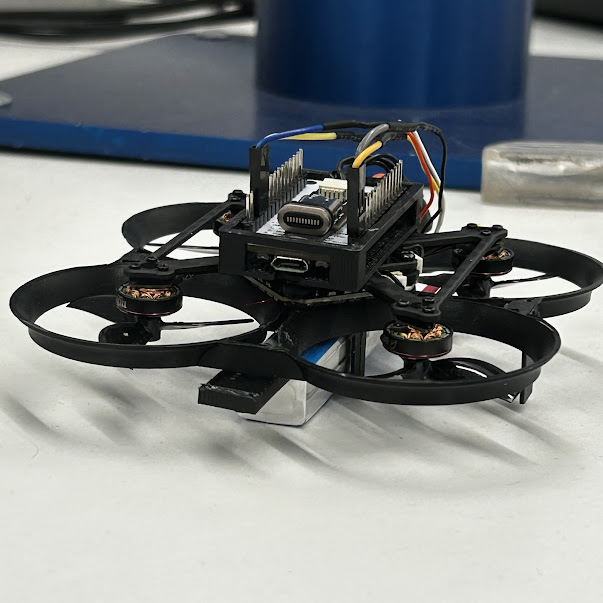
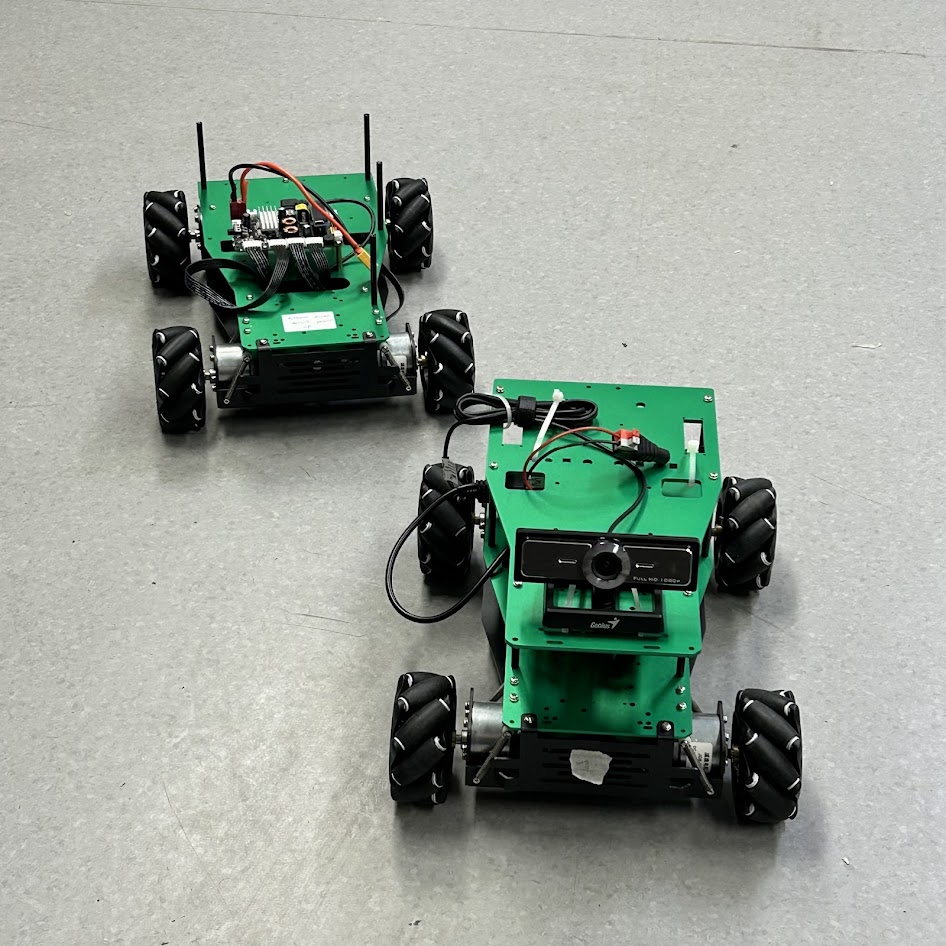
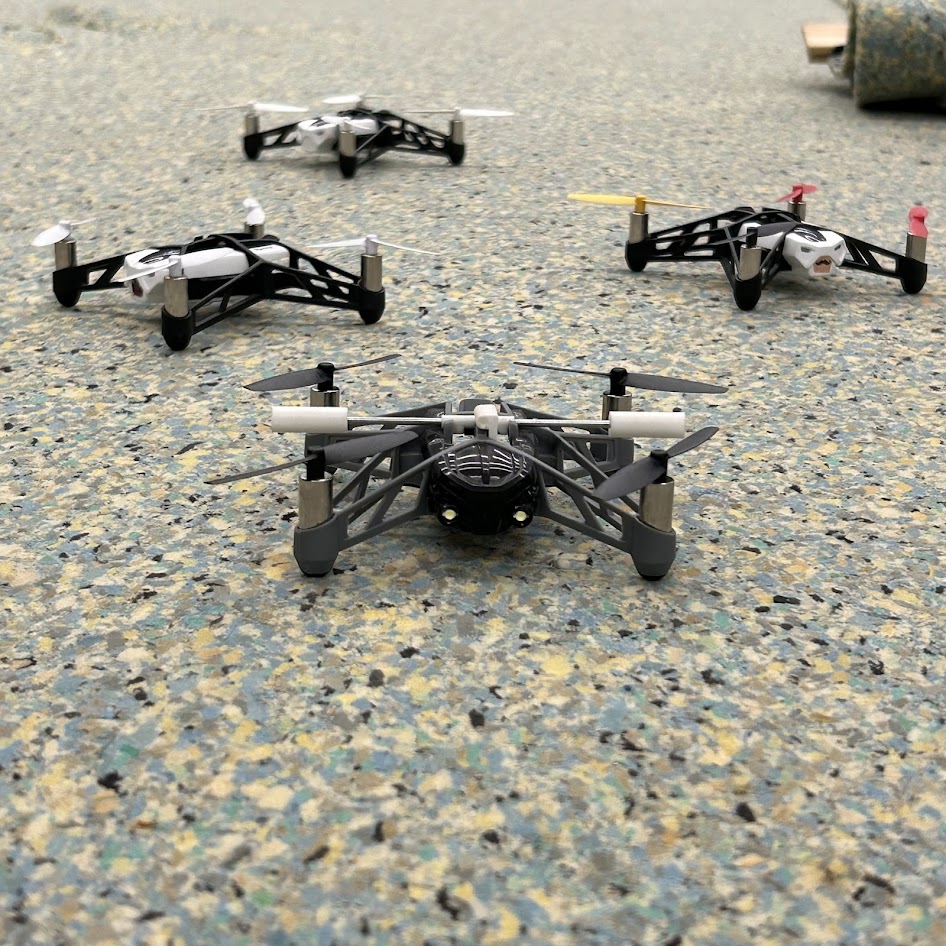
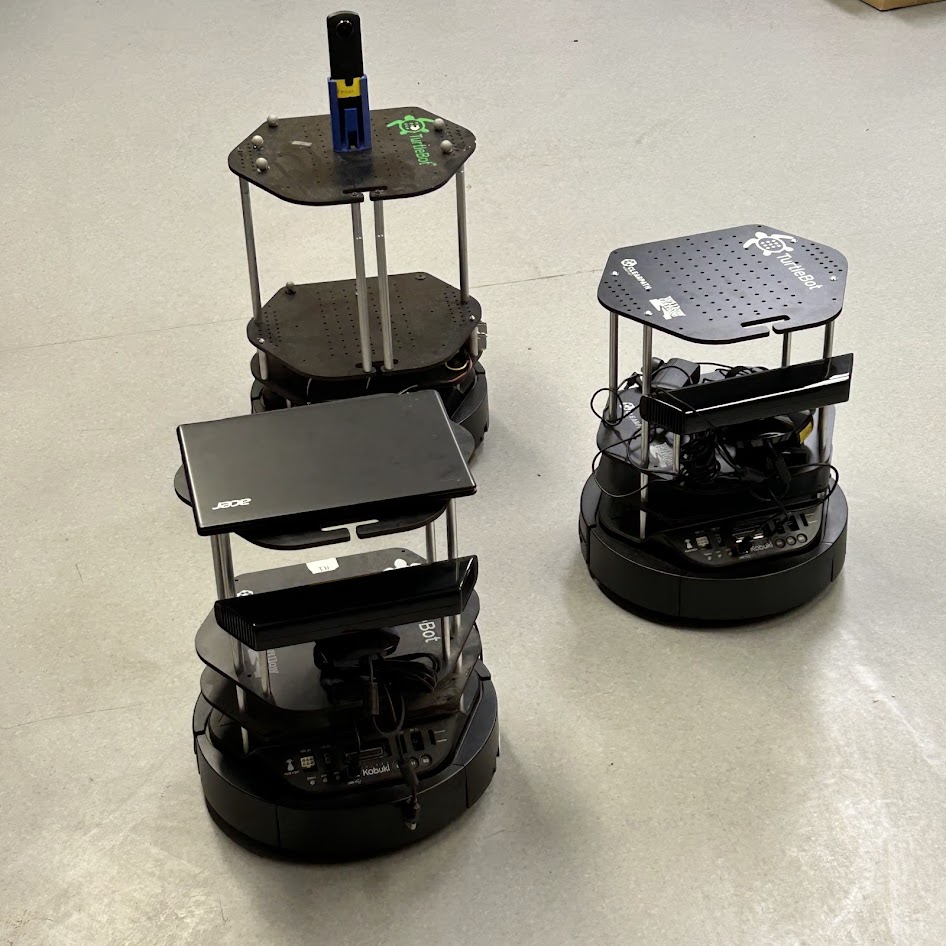
We are developing ground and aerial robots for validating multi-agent control ideas and for involving students in hands-on systems research. The current platforms maintained by the group are listed below.
Formation-control theory becomes especially useful when it can be translated into controllers for ground robots, quadrotors, and heterogeneous teams. Robotic experiments expose practical issues such as range-only measurements, limited visual sensing, actuator saturation, and the need to preserve rigidity while moving through uncertain environments.
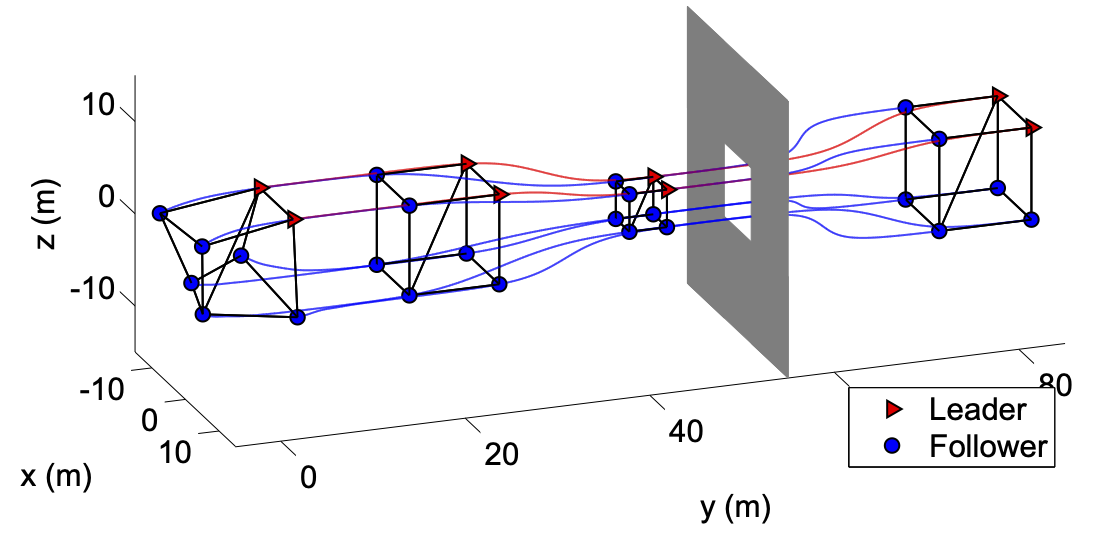
This work validates rigidity maintenance, bearing-based formation control, formation balancing, and multi-robot maneuvering on physical platforms.
Formation maneuvering and validation on multi-robot platforms.
Representative Publications:
Y. Liu, J. M. Montenbruck, D. Zelazo, M. Odelga, S. Rajappa, H. H. Bülthoff, F. Allgöwer, and A. Zell, “A Distributed Control Approach to Formation Balancing and Maneuvering of Multiple Multirotor UAVs,” IEEE Transactions on Robotics, 34(4):870–882, 2018.
@article{Liu_IEEETRo2019,
  author = {Liu, Yuyi and Montenbruck, Jan Maximilian and Zelazo, Daniel and Odelga, Marcin and Rajappa, Sujit and Bülthoff, Heinrich H. and Allgöwer, Frank and Zell, Andreas},
  journal = {IEEE Transactions on Robotics},
  title = {A Distributed Control Approach to Formation Balancing and Maneuvering of Multiple Multirotor UAVs},
  year = {2018},
  volume = {34},
  number = {4},
  pages = {870-882},
  keywords = {Shape;Robots;Decentralized control;Multi-agent systems;Collision avoidance;Convergence;Prediction algorithms;Aerial robotics;distributed formation control;human–swarm interaction;multiagent systems},
  doi = {10.1109/TRO.2018.2853606},
  pdf = {/Publications/Liu_IEEETOR2018.pdf},
  researchtopic = {robotics, formationcontrol},
  video = {https://ieeexplore.ieee.org/ielx7/8860/8437110/8429104/MediaMaterial_TRO2853606.mp4?arnumber=8429104}
}
F. Schiano, A. Franchi, D. Zelazo, and P. R. Giordano, “A Rigidity-Based Decentralized Bearing Formation Controller for Groups of Quadrotor UAVs,” in IEEE/RSJ International Conference on Intelligent Robots and Systems, Daejeon, Korea, Sep. 2016.
@inproceedings{Schiano2016a,
  address = {Daejeon, Korea},
  author = {Schiano, Fabrizio and Franchi, Antonio and Zelazo, Daniel and Giordano, {Paolo Robuffo}},
  booktitle = {IEEE/RSJ International Conference on Intelligent Robots and Systems},
  doi = {10.1109/iros.2016.7759748},
  keywords = {conference},
  month = sep,
  pages = {5099--5106},
  researchtopic = {formationcontrol, robotics},
  title = {{A Rigidity-Based Decentralized Bearing Formation Controller for Groups of Quadrotor UAVs}},
  url = {http://dx.doi.org/10.1109/iros.2016.7759748},
  year = {2016},
  video = {https://homepages.laas.fr/afranchi/robotics/sites/default/files/2016m-SchFraZelRob.mp4},
  pdf = {/Publications/Schiano_IROS16.pdf}
}
D. Zelazo, A. Franchi, H. H. Bülthoff, and P. Robuffo Giordano, “Decentralized Rigidity Maintenance Control with Range-only Measurements for Multi-Robot Systems,” International Journal of Robotics Research, 34(1):105–128, 2015.
@article{Zelazo2013a_J,
  author = {Zelazo, Daniel and Franchi, Antonio and B\"{u}lthoff, Heinrich H and {Robuffo Giordano}, Paolo},
  doi = {10.1177/0278364914546173},
  journal = {International Journal of Robotics Research},
  month = jan,
  number = {1},
  pages = {105--128},
  researchtopic = {formationcontrol, robotics},
  title = {{Decentralized Rigidity Maintenance Control with Range-only Measurements for Multi-Robot Systems}},
  url = {http://dx.doi.org/10.1177/0278364914546173},
  volume = {34},
  year = {2015},
  pdf = {/Publications/Zelazo_IJRR2015.pdf},
  video = {https://www.youtube.com/watch?v=-6F4FazmnYg}
}
D. Zelazo, A. Franchi, F. Allgöwer, H. H. Bülthoff, and P. Robuffo Giordano, “Rigidity Maintenance Control for Multi-Robot Systems,” in Proceedings of Robotics: Science and Systems, Sydney, Australia, Jul. 2012.
@inproceedings{Zelazo2012c,
  address = {Sydney, Australia},
  author = {Zelazo, Daniel and Franchi, Antonio and Allg\"{o}wer, Frank and B\"{u}lthoff, Heinrich H and {Robuffo Giordano}, Paolo},
  booktitle = {Proceedings of Robotics: Science and Systems},
  doi = {10.15607/rss.2012.viii.060},
  keywords = {conference},
  pages = {473--480},
  researchtopic = {formationcontrol, robotics},
  title = {{Rigidity Maintenance Control for Multi-Robot Systems}},
  url = {https://www.roboticsproceedings.org/rss08/index.html},
  year = {2012},
  month = jul,
  pdf = {/Publications/Zelazo_RSS12.pdf}
}
Cooperative Manipulation and Open Platforms
Robotic validation also includes cooperative manipulation and open-source platforms for control education and rapid prototyping. These projects connect the group with experimental robotics collaborators and provide reusable infrastructure for future networked-control demonstrations.
Recent work includes rigidity-based cooperative manipulation and an open-source quadcopter platform for Simulink-based control design.
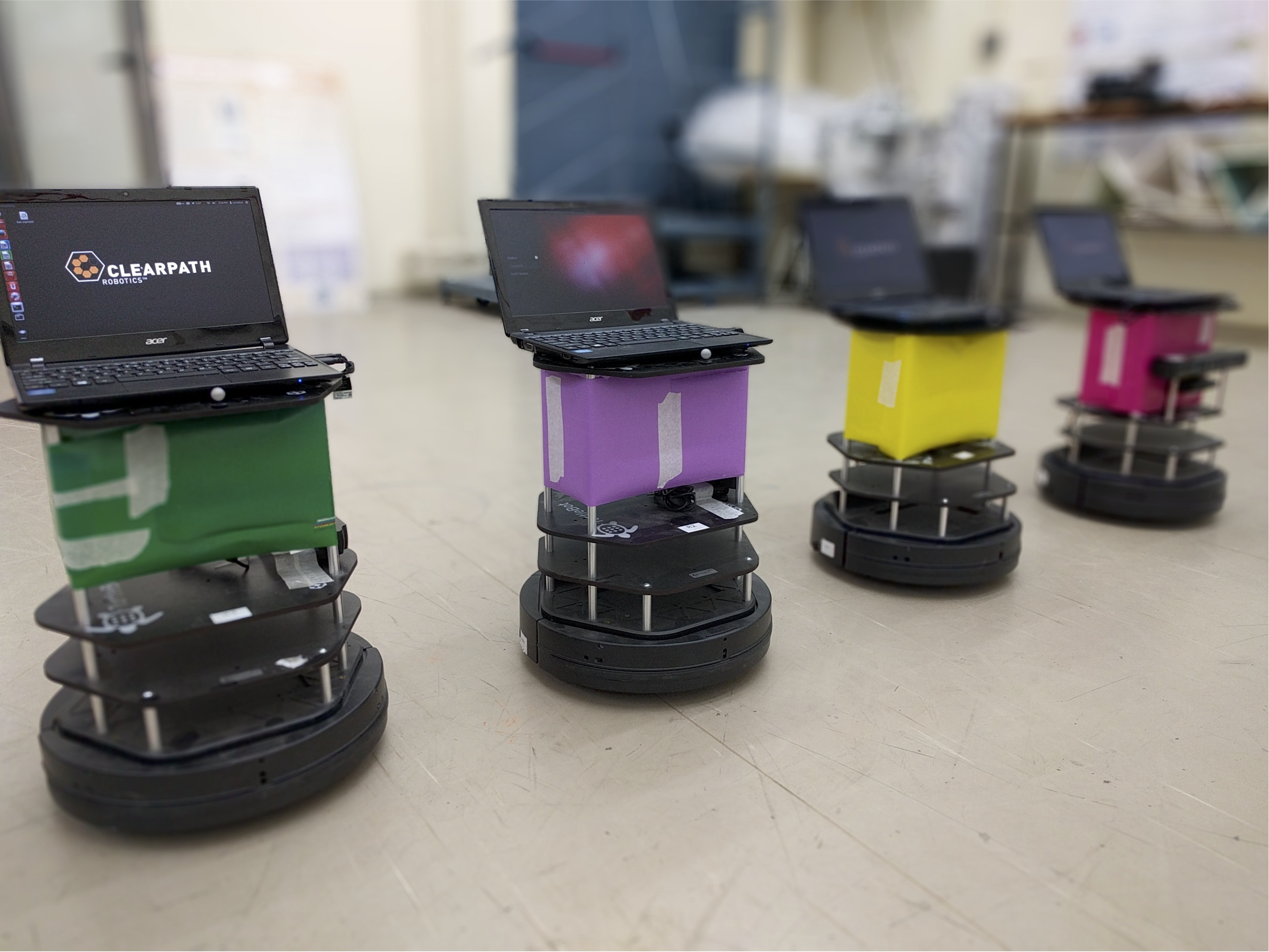
Ground-robot testbed used for multi-agent control experiments.
Representative Publications:
J. Attias, Y. Marciano, R. Arhipov, and D. Zelazo, “An Open Source Quadcopter Platform for Simulink,” in 63rd Israel Annual Conference on Aerospace Sciences, Haifa, Israel, May 2024.
@inproceedings{Attias_IACAS2024,
  address = {Haifa, Israel},
  author = {Attias, Joseph and Marciano, Yael and Arhipov, Ruslan and Zelazo, Daniel},
  booktitle = {63rd Israel Annual Conference on Aerospace Sciences},
  keywords = {conference, consensus},
  month = may,
  year = {2024},
  pages = {},
  researchtopic = {nds, robotics},
  title = {{An Open Source Quadcopter Platform for Simulink}},
  slides = {/Talks/DroneLab_IACAS_2024.pdf},
  pdf = {/Publications/Attias_IACAS2024.pdf}
}
C. K. Verginis, D. Zelazo, and D. V. Dimarogonas, “Cooperative Manipulation via Internal Force Regulation: A Rigidity Theory Perspective,” IEEE Transactions on Control of Network Systems, 10(3):1222–1233, 2023.
@article{Verginis2023_J,
  author = {Verginis, Christos K. and Zelazo, Daniel and Dimarogonas, Dimos V.},
  doi = {10.1109/TCNS.2022.3181724},
  journal = {IEEE Transactions on Control of Network Systems},
  keyword = {journal},
  number = {3},
  pages = {1222-1233},
  researchtopic = {robotics},
  title = {Cooperative Manipulation via Internal Force Regulation: A Rigidity Theory Perspective},
  url = {http://dx.doi.org/10.1109/tcns.2022.3181724},
  volume = {10},
  year = {2023},
  pdf = {/Publications/Verginis_TCNS2023.pdf},
  video = {https://www.youtube.com/watch?v=a31LTBBkE-Q}
}
N. Drellich, “Low-Cost Aerial Platform for Guidance, Navigation and Control System Design,” mastersthesis, Technion - Israel Institute of Technology, Aerospace Engineering Department, 2021.
@thesis{Drellich2021,
  author = {Drellich, Nathaniel},
  title = {Low-Cost Aerial Platform for Guidance, Navigation and Control System Design},
  school = {Technion - Israel Institute of Technology, Aerospace Engineering Department},
  year = {2021},
  type = {mastersthesis},
  researchtopic = {thesis, robotics},
  pdf = {/Theses/Thesis_Drellich.pdf}
}
Complete Related Publications
Related Publications:
J. Attias, Y. Marciano, R. Arhipov, and D. Zelazo, “An Open Source Quadcopter Platform for Simulink,” in 63rd Israel Annual Conference on Aerospace Sciences, Haifa, Israel, May 2024.
@inproceedings{Attias_IACAS2024,
  address = {Haifa, Israel},
  author = {Attias, Joseph and Marciano, Yael and Arhipov, Ruslan and Zelazo, Daniel},
  booktitle = {63rd Israel Annual Conference on Aerospace Sciences},
  keywords = {conference, consensus},
  month = may,
  year = {2024},
  pages = {},
  researchtopic = {nds, robotics},
  title = {{An Open Source Quadcopter Platform for Simulink}},
  slides = {/Talks/DroneLab_IACAS_2024.pdf},
  pdf = {/Publications/Attias_IACAS2024.pdf}
}
C. K. Verginis, D. Zelazo, and D. V. Dimarogonas, “Cooperative Manipulation via Internal Force Regulation: A Rigidity Theory Perspective,” IEEE Transactions on Control of Network Systems, 10(3):1222–1233, 2023.
@article{Verginis2023_J,
  author = {Verginis, Christos K. and Zelazo, Daniel and Dimarogonas, Dimos V.},
  doi = {10.1109/TCNS.2022.3181724},
  journal = {IEEE Transactions on Control of Network Systems},
  keyword = {journal},
  number = {3},
  pages = {1222-1233},
  researchtopic = {robotics},
  title = {Cooperative Manipulation via Internal Force Regulation: A Rigidity Theory Perspective},
  url = {http://dx.doi.org/10.1109/tcns.2022.3181724},
  volume = {10},
  year = {2023},
  pdf = {/Publications/Verginis_TCNS2023.pdf},
  video = {https://www.youtube.com/watch?v=a31LTBBkE-Q}
}
N. Drellich, “Low-Cost Aerial Platform for Guidance, Navigation and Control System Design,” mastersthesis, Technion - Israel Institute of Technology, Aerospace Engineering Department, 2021.
@thesis{Drellich2021,
  author = {Drellich, Nathaniel},
  title = {Low-Cost Aerial Platform for Guidance, Navigation and Control System Design},
  school = {Technion - Israel Institute of Technology, Aerospace Engineering Department},
  year = {2021},
  type = {mastersthesis},
  researchtopic = {thesis, robotics},
  pdf = {/Theses/Thesis_Drellich.pdf}
}
Y. Liu, J. M. Montenbruck, D. Zelazo, M. Odelga, S. Rajappa, H. H. Bülthoff, F. Allgöwer, and A. Zell, “A Distributed Control Approach to Formation Balancing and Maneuvering of Multiple Multirotor UAVs,” IEEE Transactions on Robotics, 34(4):870–882, 2018.
@article{Liu_IEEETRo2019,
  author = {Liu, Yuyi and Montenbruck, Jan Maximilian and Zelazo, Daniel and Odelga, Marcin and Rajappa, Sujit and Bülthoff, Heinrich H. and Allgöwer, Frank and Zell, Andreas},
  journal = {IEEE Transactions on Robotics},
  title = {A Distributed Control Approach to Formation Balancing and Maneuvering of Multiple Multirotor UAVs},
  year = {2018},
  volume = {34},
  number = {4},
  pages = {870-882},
  keywords = {Shape;Robots;Decentralized control;Multi-agent systems;Collision avoidance;Convergence;Prediction algorithms;Aerial robotics;distributed formation control;human–swarm interaction;multiagent systems},
  doi = {10.1109/TRO.2018.2853606},
  pdf = {/Publications/Liu_IEEETOR2018.pdf},
  researchtopic = {robotics, formationcontrol},
  video = {https://ieeexplore.ieee.org/ielx7/8860/8437110/8429104/MediaMaterial_TRO2853606.mp4?arnumber=8429104}
}
F. Schiano, A. Franchi, D. Zelazo, and P. R. Giordano, “A Rigidity-Based Decentralized Bearing Formation Controller for Groups of Quadrotor UAVs,” in IEEE/RSJ International Conference on Intelligent Robots and Systems, Daejeon, Korea, Sep. 2016.
@inproceedings{Schiano2016a,
  address = {Daejeon, Korea},
  author = {Schiano, Fabrizio and Franchi, Antonio and Zelazo, Daniel and Giordano, {Paolo Robuffo}},
  booktitle = {IEEE/RSJ International Conference on Intelligent Robots and Systems},
  doi = {10.1109/iros.2016.7759748},
  keywords = {conference},
  month = sep,
  pages = {5099--5106},
  researchtopic = {formationcontrol, robotics},
  title = {{A Rigidity-Based Decentralized Bearing Formation Controller for Groups of Quadrotor UAVs}},
  url = {http://dx.doi.org/10.1109/iros.2016.7759748},
  year = {2016},
  video = {https://homepages.laas.fr/afranchi/robotics/sites/default/files/2016m-SchFraZelRob.mp4},
  pdf = {/Publications/Schiano_IROS16.pdf}
}
D. Zelazo, A. Franchi, H. H. Bülthoff, and P. Robuffo Giordano, “Decentralized Rigidity Maintenance Control with Range-only Measurements for Multi-Robot Systems,” International Journal of Robotics Research, 34(1):105–128, 2015.
@article{Zelazo2013a_J,
  author = {Zelazo, Daniel and Franchi, Antonio and B\"{u}lthoff, Heinrich H and {Robuffo Giordano}, Paolo},
  doi = {10.1177/0278364914546173},
  journal = {International Journal of Robotics Research},
  month = jan,
  number = {1},
  pages = {105--128},
  researchtopic = {formationcontrol, robotics},
  title = {{Decentralized Rigidity Maintenance Control with Range-only Measurements for Multi-Robot Systems}},
  url = {http://dx.doi.org/10.1177/0278364914546173},
  volume = {34},
  year = {2015},
  pdf = {/Publications/Zelazo_IJRR2015.pdf},
  video = {https://www.youtube.com/watch?v=-6F4FazmnYg}
}
D. Zelazo, A. Franchi, F. Allgöwer, H. H. Bülthoff, and P. Robuffo Giordano, “Rigidity Maintenance Control for Multi-Robot Systems,” in Proceedings of Robotics: Science and Systems, Sydney, Australia, Jul. 2012.
@inproceedings{Zelazo2012c,
  address = {Sydney, Australia},
  author = {Zelazo, Daniel and Franchi, Antonio and Allg\"{o}wer, Frank and B\"{u}lthoff, Heinrich H and {Robuffo Giordano}, Paolo},
  booktitle = {Proceedings of Robotics: Science and Systems},
  doi = {10.15607/rss.2012.viii.060},
  keywords = {conference},
  pages = {473--480},
  researchtopic = {formationcontrol, robotics},
  title = {{Rigidity Maintenance Control for Multi-Robot Systems}},
  url = {https://www.roboticsproceedings.org/rss08/index.html},
  year = {2012},
  month = jul,
  pdf = {/Publications/Zelazo_RSS12.pdf}
}