Large-scale networked systems must continue to operate despite uncertainty, faults, communication failures, and malicious interference. Security and resilience therefore need to be part of the control architecture, not only an after-the-fact detection layer.
Our work studies secure-by-design consensus, robustness of networked dynamics, structural resilience, and fault-tolerant graph properties. The emphasis on this page is the robustness and security layer; related consensus and network-identification methods are handled on their own pages when that is the primary contribution.
Secure-by-Design Consensus
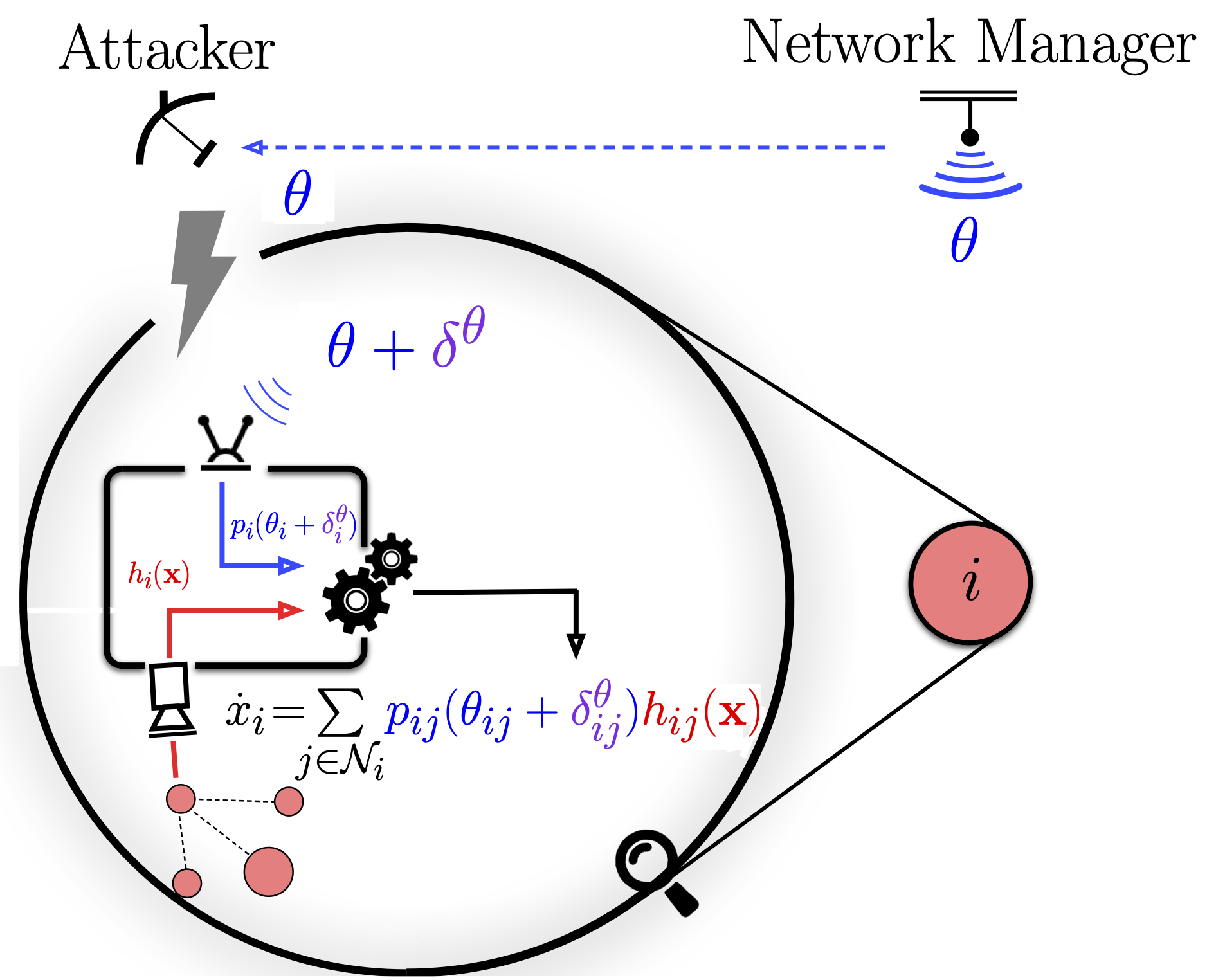
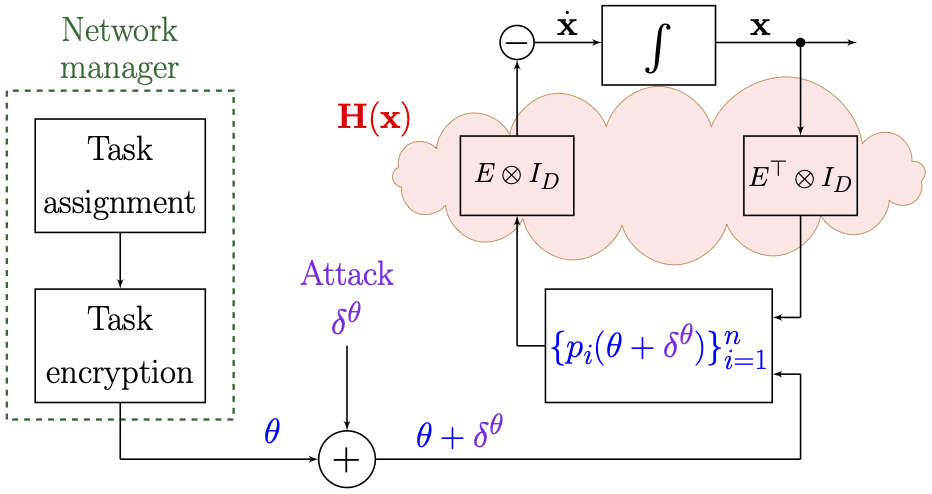
Secure-by-design consensus modifies the information exchanged over the network so that channel tampering can be detected or mitigated by the protocol structure itself. Instead of treating attacks as external disturbances, the controller architecture encodes redundancy and objective information directly into the consensus process.
Our work develops objective-coding methods and robustness analysis tools for structured channel tampering in consensus networks.
Secure-by-design consensus architecture for detecting structured channel tampering.
Representative Publications:
M. Fabris and D. Zelazo, “A Robustness Analysis to Structured Channel Tampering Over Secure-by-Design Consensus Networks,” IEEE Control Systems Letters, 7:2011–2016, 2023.
@article{Fabris2023_J,
  author = {Fabris, Marco and Zelazo, Daniel},
  doi = {10.1109/LCSYS.2023.3284482},
  journal = {IEEE Control Systems Letters},
  keyword = {journal},
  number = {},
  pages = {2011-2016},
  researchtopic = {nds, robust},
  title = {A Robustness Analysis to Structured Channel Tampering Over Secure-by-Design Consensus Networks},
  url = {http://dx.doi.org/10.1109/lcsys.2023.3284482},
  volume = {7},
  year = {2023},
  pdf = {/Publications/Fabris_LCSS2023.pdf},
  slides = {/Talks/CDC2023_Fabris.pdf}
}
M. Fabris and D. Zelazo, “Secure Consensus via Objective Coding: Robustness Analysis to Channel Tampering,” IEEE Transactions on Systems, Man and Cybernetics: Systems, 52(12):7885–7897, 2022.
@article{Fabris2022a_J,
  author = {Fabris, Marco and Zelazo, Daniel},
  doi = {10.1109/tsmc.2022.3177756},
  journal = {IEEE Transactions on Systems, Man and Cybernetics: Systems},
  keyword = {journal},
  month = jun,
  number = {12},
  pages = {7885--7897},
  researchtopic = {nds, robust},
  title = {Secure Consensus via Objective Coding: Robustness Analysis to Channel Tampering},
  url = {http://dx.doi.org/10.1109/tsmc.2022.3177756},
  volume = {52},
  year = {2022},
  pdf = {/Publications/Fabris_SMCS2022.pdf}
}
Robust Consensus and Network Uncertainty
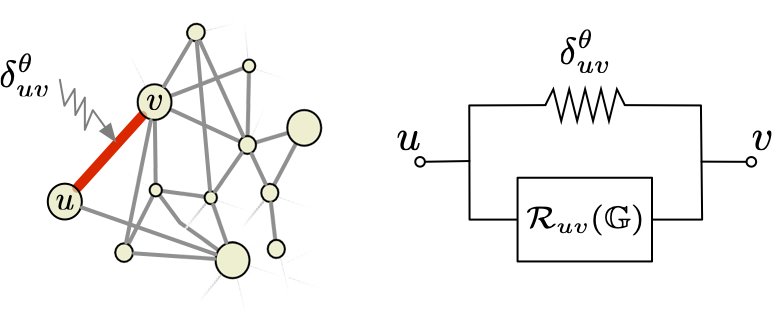
Robust consensus asks how graph weights, uncertainty, heterogeneity, and higher-order agent dynamics affect the ability of a network to reach agreement. These questions are especially important when the communication graph is weighted, directed, or only approximately known.
This work develops robustness measures, uncertainty analysis, and graph-dependent tools for consensus networks under model mismatch and heterogeneous dynamics.
Graph-theoretic robustness measures for uncertain consensus networks.
Representative Publications:
D. Mukherjee and D. Zelazo, “Robustness of Consensus over Weighted Digraphs,” IEEE Transactions on Network Sciences and Engineering, 6(4):657–670, 2019.
@article{Muhkerjee2017a_J,
  author = {Mukherjee, Dwaipayan and Zelazo, Daniel},
  doi = {10.1109/tnse.2018.2866780},
  journal = {IEEE Transactions on Network Sciences and Engineering},
  month = dec,
  number = {4},
  pages = {657--670},
  researchtopic = {nds, graphs, robust},
  title = {Robustness of Consensus over Weighted Digraphs},
  url = {http://dx.doi.org/10.1109/tnse.2018.2866780},
  volume = {6},
  year = {2019},
  pdf = {/Publications/Muhkerejee_TNSE2017.pdf}
}
D. Mukherjee and D. Zelazo, “Consensus of Higher Order Agents: Robustness and Heterogeneity,” IEEE Transactions on Control of Network Systems, 6(4):1323–1333, 2019.
@article{Muhkerjee2017b_J,
  author = {Mukherjee, Dwaipayan and Zelazo, Daniel},
  doi = {10.1109/tcns.2018.2889003},
  journal = {IEEE Transactions on Control of Network Systems},
  keyword = {journal},
  month = dec,
  number = {4},
  pages = {1323--1333},
  researchtopic = {nds, robust},
  title = {Consensus of Higher Order Agents: Robustness and Heterogeneity},
  url = {http://dx.doi.org/10.1109/tcns.2018.2889003},
  volume = {6},
  year = {2019},
  pdf = {/Publications/Mukherjee_TCNS2019.pdf}
}
D. Mukherjee and D. Zelazo, “Robust Consensus of Higher Order Agents over Cycle Graphs,” in 58th Israel Annual Conference on Aerospace Sciences, Haifa, Israel, Mar. 2018.
@inproceedings{Mukherjee2016a,
  address = {Haifa, Israel},
  author = {Mukherjee, Dwaipayan and Zelazo, Daniel},
  booktitle = {58th Israel Annual Conference on Aerospace Sciences},
  keywords = {conference},
  month = mar,
  pages = {},
  researchtopic = {nds, robust},
  title = {{Robust Consensus of Higher Order Agents over Cycle Graphs}},
  year = {2018},
  slides = {/Talks/IACAS2018_Mukherjee.pdf},
  pdf = {/Publications/Mukherjee_IACAS2018.pdf}
}
D. Zelazo and M. Bürger, “On the Robustness of Uncertain Consensus Networks,” IEEE Transactions on Control of Network Systems, 4(2):170–178, 2017.
@article{Zelazo2014a_J,
  author = {{Zelazo}, D. and {B{\"u}rger}, M.},
  doi = {10.1109/tcns.2015.2485458},
  journal = {IEEE Transactions on Control of Network Systems},
  keywords = {Mathematics - Optimization and Control},
  month = jun,
  number = {2},
  pages = {170--178},
  researchtopic = {nds, robust},
  title = {{On the Robustness of Uncertain Consensus Networks}},
  url = {http://dx.doi.org/10.1109/tcns.2015.2485458},
  volume = {4},
  year = {2017},
  pdf = {/Publications/Zelazo_TCNS2014.pdf}
}
D. Mukherjee and D. Zelazo, “Consensus Over Weighted Digraphs: A Robustness Perspective,” in 55th IEEE Conference on Decision and Control, Las Vegas, Nevada, Dec. 2016.
@inproceedings{Mukherjee2016b,
  address = {Las Vegas, Nevada},
  author = {Mukherjee, Dwaipayan and Zelazo, Daniel},
  booktitle = {55th IEEE Conference on Decision and Control},
  doi = {10.1109/cdc.2016.7798784},
  keywords = {conference},
  month = dec,
  pages = {3438--3443},
  researchtopic = {nds, robust},
  title = {{Consensus Over Weighted Digraphs: A Robustness Perspective}},
  url = {http://dx.doi.org/10.1109/cdc.2016.7798784},
  year = {2016},
  pdf = {/Publications/Mukherjee_CDC16.pdf}
}
Structural Resilience and Fault Tolerance
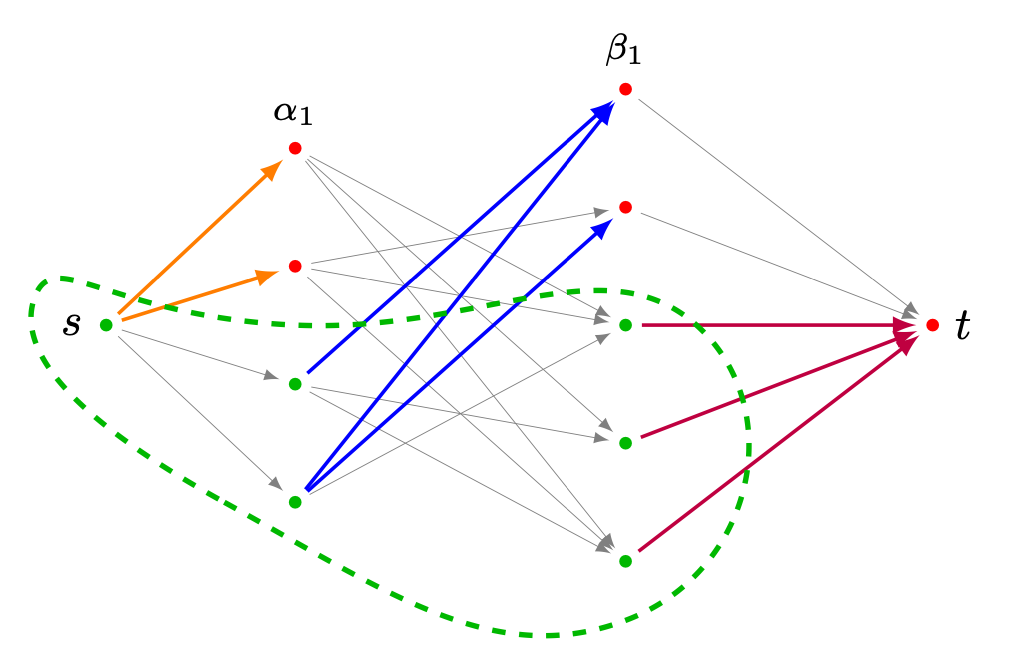
Some resilience questions depend mainly on structure: which sparsity patterns preserve rank, how many faults can a cluster assignment tolerate, and where does the graph architecture create unavoidable vulnerability? These problems require tools from structural systems theory, graph theory, and combinatorics.
Our work studies structural rank, resilience of sparsity patterns, and fault-tolerant cluster assignment in multi-agent systems.
Structural-rank tools for certifying resilience of network sparsity patterns.
Representative Publications:
M. Sharf and D. Zelazo, “Cluster assignment in multi-agent systems: Sparsity bounds and fault tolerance,” Asian Journal of Control, 27(1):63–75, 2025.
@article{Sharf2025a_J,
  author = {Sharf, Miel and Zelazo, Daniel},
  doi = {10.1002/asjc.3149},
  journal = {Asian Journal of Control},
  keywords = {clustering, diffusive coupling, fault tolerance, graph theory, multi-agent networks, sparsity},
  researchtopic = {nds, robust},
  title = {Cluster assignment in multi-agent systems: Sparsity bounds and fault tolerance},
  url = {https://onlinelibrary.wiley.com/doi/10.1002/asjc.3149},
  year = {2025},
  volume = {27},
  number = {1},
  pages = {63--75},
  pdf = {/Publications/Sharf_AJC2025.pdf}
}
M.-A. Belabbas, X. Chen, and D. Zelazo, “On Structural Rank and Resilience of Sparsity Patterns,” IEEE Transactions on Automatic Control, 68(8):4783–4795, 2023.
@article{Belabbas2021a_J,
  author = {Belabbas, M-A and Chen, Xudong and Zelazo, Daniel},
  doi = {10.1109/tac.2022.3212013},
  journal = {IEEE Transactions on Automatic Control},
  keyword = {journal},
  month = aug,
  number = {8},
  pages = {4783 - 4795},
  researchtopic = {graphs, nds, robust},
  title = {On Structural Rank and Resilience of Sparsity Patterns},
  url = {http://dx.doi.org/10.1109/tac.2022.3212013},
  volume = {68},
  year = {2023},
  pdf = {/Publications/Belabbas_TAC2023.pdf}
}
Complete Related Publications
Related Publications:
M. Sharf and D. Zelazo, “Cluster assignment in multi-agent systems: Sparsity bounds and fault tolerance,” Asian Journal of Control, 27(1):63–75, 2025.
@article{Sharf2025a_J,
  author = {Sharf, Miel and Zelazo, Daniel},
  doi = {10.1002/asjc.3149},
  journal = {Asian Journal of Control},
  keywords = {clustering, diffusive coupling, fault tolerance, graph theory, multi-agent networks, sparsity},
  researchtopic = {nds, robust},
  title = {Cluster assignment in multi-agent systems: Sparsity bounds and fault tolerance},
  url = {https://onlinelibrary.wiley.com/doi/10.1002/asjc.3149},
  year = {2025},
  volume = {27},
  number = {1},
  pages = {63--75},
  pdf = {/Publications/Sharf_AJC2025.pdf}
}
M.-A. Belabbas, X. Chen, and D. Zelazo, “On Structural Rank and Resilience of Sparsity Patterns,” IEEE Transactions on Automatic Control, 68(8):4783–4795, 2023.
@article{Belabbas2021a_J,
  author = {Belabbas, M-A and Chen, Xudong and Zelazo, Daniel},
  doi = {10.1109/tac.2022.3212013},
  journal = {IEEE Transactions on Automatic Control},
  keyword = {journal},
  month = aug,
  number = {8},
  pages = {4783 - 4795},
  researchtopic = {graphs, nds, robust},
  title = {On Structural Rank and Resilience of Sparsity Patterns},
  url = {http://dx.doi.org/10.1109/tac.2022.3212013},
  volume = {68},
  year = {2023},
  pdf = {/Publications/Belabbas_TAC2023.pdf}
}
M. Fabris and D. Zelazo, “A Robustness Analysis to Structured Channel Tampering Over Secure-by-Design Consensus Networks,” IEEE Control Systems Letters, 7:2011–2016, 2023.
@article{Fabris2023_J,
  author = {Fabris, Marco and Zelazo, Daniel},
  doi = {10.1109/LCSYS.2023.3284482},
  journal = {IEEE Control Systems Letters},
  keyword = {journal},
  number = {},
  pages = {2011-2016},
  researchtopic = {nds, robust},
  title = {A Robustness Analysis to Structured Channel Tampering Over Secure-by-Design Consensus Networks},
  url = {http://dx.doi.org/10.1109/lcsys.2023.3284482},
  volume = {7},
  year = {2023},
  pdf = {/Publications/Fabris_LCSS2023.pdf},
  slides = {/Talks/CDC2023_Fabris.pdf}
}
M. Fabris and D. Zelazo, “Secure Consensus via Objective Coding: Robustness Analysis to Channel Tampering,” IEEE Transactions on Systems, Man and Cybernetics: Systems, 52(12):7885–7897, 2022.
@article{Fabris2022a_J,
  author = {Fabris, Marco and Zelazo, Daniel},
  doi = {10.1109/tsmc.2022.3177756},
  journal = {IEEE Transactions on Systems, Man and Cybernetics: Systems},
  keyword = {journal},
  month = jun,
  number = {12},
  pages = {7885--7897},
  researchtopic = {nds, robust},
  title = {Secure Consensus via Objective Coding: Robustness Analysis to Channel Tampering},
  url = {http://dx.doi.org/10.1109/tsmc.2022.3177756},
  volume = {52},
  year = {2022},
  pdf = {/Publications/Fabris_SMCS2022.pdf}
}
D. Mukherjee and D. Zelazo, “Robustness of Consensus over Weighted Digraphs,” IEEE Transactions on Network Sciences and Engineering, 6(4):657–670, 2019.
@article{Muhkerjee2017a_J,
  author = {Mukherjee, Dwaipayan and Zelazo, Daniel},
  doi = {10.1109/tnse.2018.2866780},
  journal = {IEEE Transactions on Network Sciences and Engineering},
  month = dec,
  number = {4},
  pages = {657--670},
  researchtopic = {nds, graphs, robust},
  title = {Robustness of Consensus over Weighted Digraphs},
  url = {http://dx.doi.org/10.1109/tnse.2018.2866780},
  volume = {6},
  year = {2019},
  pdf = {/Publications/Muhkerejee_TNSE2017.pdf}
}
D. Mukherjee and D. Zelazo, “Consensus of Higher Order Agents: Robustness and Heterogeneity,” IEEE Transactions on Control of Network Systems, 6(4):1323–1333, 2019.
@article{Muhkerjee2017b_J,
  author = {Mukherjee, Dwaipayan and Zelazo, Daniel},
  doi = {10.1109/tcns.2018.2889003},
  journal = {IEEE Transactions on Control of Network Systems},
  keyword = {journal},
  month = dec,
  number = {4},
  pages = {1323--1333},
  researchtopic = {nds, robust},
  title = {Consensus of Higher Order Agents: Robustness and Heterogeneity},
  url = {http://dx.doi.org/10.1109/tcns.2018.2889003},
  volume = {6},
  year = {2019},
  pdf = {/Publications/Mukherjee_TCNS2019.pdf}
}
D. Mukherjee and D. Zelazo, “Robust Consensus of Higher Order Agents over Cycle Graphs,” in 58th Israel Annual Conference on Aerospace Sciences, Haifa, Israel, Mar. 2018.
@inproceedings{Mukherjee2016a,
  address = {Haifa, Israel},
  author = {Mukherjee, Dwaipayan and Zelazo, Daniel},
  booktitle = {58th Israel Annual Conference on Aerospace Sciences},
  keywords = {conference},
  month = mar,
  pages = {},
  researchtopic = {nds, robust},
  title = {{Robust Consensus of Higher Order Agents over Cycle Graphs}},
  year = {2018},
  slides = {/Talks/IACAS2018_Mukherjee.pdf},
  pdf = {/Publications/Mukherjee_IACAS2018.pdf}
}
D. Zelazo and M. Bürger, “On the Robustness of Uncertain Consensus Networks,” IEEE Transactions on Control of Network Systems, 4(2):170–178, 2017.
@article{Zelazo2014a_J,
  author = {{Zelazo}, D. and {B{\"u}rger}, M.},
  doi = {10.1109/tcns.2015.2485458},
  journal = {IEEE Transactions on Control of Network Systems},
  keywords = {Mathematics - Optimization and Control},
  month = jun,
  number = {2},
  pages = {170--178},
  researchtopic = {nds, robust},
  title = {{On the Robustness of Uncertain Consensus Networks}},
  url = {http://dx.doi.org/10.1109/tcns.2015.2485458},
  volume = {4},
  year = {2017},
  pdf = {/Publications/Zelazo_TCNS2014.pdf}
}
D. Mukherjee and D. Zelazo, “Consensus Over Weighted Digraphs: A Robustness Perspective,” in 55th IEEE Conference on Decision and Control, Las Vegas, Nevada, Dec. 2016.
@inproceedings{Mukherjee2016b,
  address = {Las Vegas, Nevada},
  author = {Mukherjee, Dwaipayan and Zelazo, Daniel},
  booktitle = {55th IEEE Conference on Decision and Control},
  doi = {10.1109/cdc.2016.7798784},
  keywords = {conference},
  month = dec,
  pages = {3438--3443},
  researchtopic = {nds, robust},
  title = {{Consensus Over Weighted Digraphs: A Robustness Perspective}},
  url = {http://dx.doi.org/10.1109/cdc.2016.7798784},
  year = {2016},
  pdf = {/Publications/Mukherjee_CDC16.pdf}
}